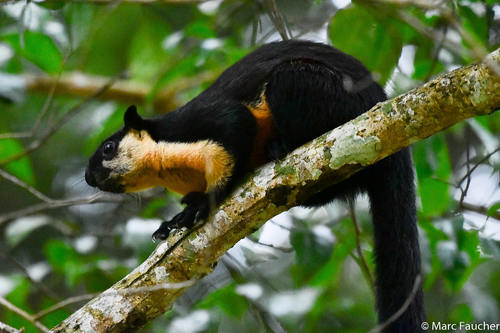
Black Giant Squirrel
Ratufa bicolor
One of the world's largest squirrels, this 'Olympic athlete' of the canopy is famous for its massive tail and incredible 20-foot leaps between tropical trees.
Quick Identification
Size
Head-body length of 35–58 cm (14–23 in), with a tail length of 45–60 cm (18–24 in); total weight ranges from 1–1.6 kg (2.2–3.5 lb).
Colors
Upperparts are jet black or dark chocolate brown; underparts and the inside of limbs are creamy white or pale yellow; dark circles around eyes.
Key Features
- Massive bushy tail often longer than the head and body combined
- Striking contrast between black dorsal fur and cream-colored belly
- Short, rounded ears with distinct fur tufts
- Large, robust build significantly bigger than common garden squirrels
When You’ll See Them
Geographic range
Where Does the Black Giant Squirrel Live?
The Black Giant Squirrel is native to the Indomalayan realm, spanning a vast territory across South and Southeast Asia. Its core range includes the tropical forests of northern India, Nepal, and Bhutan, extending eastward through Myanmar, Thailand, and the Malay Peninsula into the islands of western Indonesia like Sumatra and Java. While it remains a staple of undisturbed evergreen landscapes, its presence is increasingly restricted to protected areas within these countries due to habitat fragmentation.
Basemap © OpenStreetMap contributors
Behavior
The Black Giant Squirrel is a strictly diurnal and almost exclusively arboreal acrobat. Spending the vast majority of its life in the high canopy, it is known for its incredible agility, capable of making leaps of up to 6 meters (20 feet) between branches. Unlike many smaller squirrel species, they are generally solitary and highly territorial, though they may be seen in pairs during the breeding season. They are relatively shy and will often flatten themselves against a branch to remain motionless if they sense a predator nearby.
When active, they are vocal animals, producing a loud, staccato 'chuk-chuk-chuk' call that resonates through the forest. While they rarely descend to the forest floor, they may do so occasionally to cross gaps in the canopy or to forage for fallen fruits. In areas near human settlements, they tend to remain cautious and will retreat into dense foliage at the first sign of movement, making them a prize for patient wildlife observers.
EverydayEarth exclusive
Camera Tips
Capturing the Black Giant Squirrel requires thinking vertically. Because this species rarely touches the ground, standard trail camera placement at knee height will likely yield zero results. Instead, look for 'canopy bridges'—horizontal branches that connect two large trees. Use a secure climbing ladder or a professional mounting pole to place your camera 15 to 30 feet up. Angle the camera slightly downward along the length of a flat, sturdy branch where the squirrel is likely to pause or feed.
While these squirrels are naturally wary, they are highly motivated by seasonal fruit. If you have a fruiting tree like a wild fig or a jackfruit on your property, focus your efforts there. Unlike smaller squirrels that zip around, the Black Giant Squirrel often sits in one spot for 10-15 minutes to dismantle a large fruit or seed pod. Set your camera to take short video clips (15-20 seconds) rather than just stills to capture their unique feeding posture—they often hang by their hind legs to reach distant fruit.
Lighting is your biggest challenge in the dense canopy. To avoid 'white-out' from sunlight filtering through leaves, use a camera with a high-quality CMOS sensor and set your trigger speed to the fastest possible setting to catch their rapid leaps. If you are using a lure, a smudge of peanut butter or a halved piece of fruit secured to a branch can encourage them to stay within the camera's focal range long enough for a clear shot.
Similar Species
Species that look similar or are commonly confused with Black Giant Squirrel.
Frequently Asked Questions
Record Black Giant Squirrel at your habitat
Connect a camera to start building your own species record — AI identifies every visitor automatically.