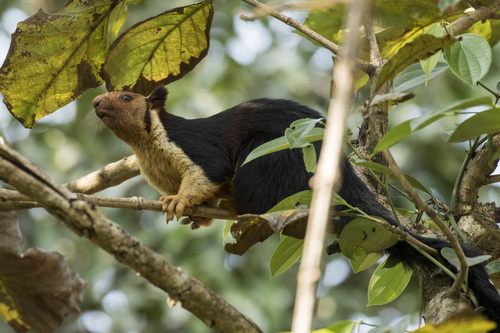
Indian Giant Squirrel
Ratufa indica
Often called the 'rainbow squirrel,' this spectacular forest dweller is one of the largest squirrel species in the world. With its vibrant maroon fur and incredible leaping ability, it is a crown jewel of the Indian canopy.
Quick Identification
Size
Body length 25–45 cm (10–18 in), with a tail length of approximately 60 cm (2 ft); weights range from 1.5–2 kg (3.3–4.4 lbs).
Colors
A striking mosaic of maroon, deep purple, black, orange-brown, and creamy-white; typically features a creamy-white belly and a bicolored or dark bushy tail.
Key Features
- Massive size, often reaching 1 meter in total length
- Luxurious, bushy tail that exceeds the body length
- Distinctive multi-colored coat with deep maroon patches
- Small, rounded ears with prominent fur tufts
When You’ll See Them
Geographic range
Where Does the Indian Giant Squirrel Live?
The Indian Giant Squirrel is a jewel of the Asian continent, found exclusively within the borders of India. It is endemic to the peninsula, with its core populations thriving in the lush Western Ghats, parts of the Eastern Ghats, and the rugged Satpura Range. While its distribution is fragmented due to habitat loss, it remains a flagship species for the diverse forest ecosystems of central and southern India, and no introduced populations exist outside its native range.
Basemap © OpenStreetMap contributors
Behavior
The Indian Giant Squirrel is a master of the forest canopy, rarely descending to the forest floor. These squirrels are diurnal, meaning they are most active during the daylight hours, particularly in the early morning and late afternoon. They are incredibly agile, capable of making massive leaps of up to 6 meters (20 feet) between tree branches to escape predators like leopards or crested hawk-eagles.
While they are primarily solitary creatures, they may be seen in pairs during the breeding season. They are known for building multiple large, globular nests called 'dreys' out of twigs and leaves, using different nests for sleeping and nurseries. When threatened, rather than fleeing immediately, they often flatten themselves against a tree trunk, remaining perfectly still to blend into the dappled sunlight of the bark.
EverydayEarth exclusive
Camera Tips
Capturing the Indian Giant Squirrel on an AI-powered camera requires a departure from standard ground-level setups. Because these squirrels are strictly arboreal, you must mount your camera high in the canopy. Look for 'arboreal highways'—thick, horizontal branches that connect different sections of the forest. Secure your camera at a height of at least 15 to 20 feet if possible, angled slightly downward along the length of a branch where you see signs of activity, such as gnawed nut shells or stripped bark.
Since these squirrels are most active during the golden hours of early morning and late afternoon, ensure your camera's sensitivity is optimized for these lighting conditions. If your camera allows for video, set it to record short bursts (15–30 seconds) rather than just stills. These animals move with sudden, explosive power; a fast trigger speed is essential to avoid capturing just a blur of a maroon tail. High-resolution settings are a must to capture the intricate details of their multi-colored fur.
While we don't recommend heavy baiting which can disrupt natural foraging, placing a few local wild fruits or nuts on a flat section of a branch within the camera's field of view can encourage the squirrel to pause long enough for a clear shot. Avoid using artificial scents or human food. During the monsoon season, the squirrels are very active, but ensure your camera housing is fully waterproofed and check for lens fogging, which is common in their humid forest habitats.
Similar Species
Species that look similar or are commonly confused with Indian Giant Squirrel.
Frequently Asked Questions
Record Indian Giant Squirrel at your habitat
Connect a camera to start building your own species record — AI identifies every visitor automatically.