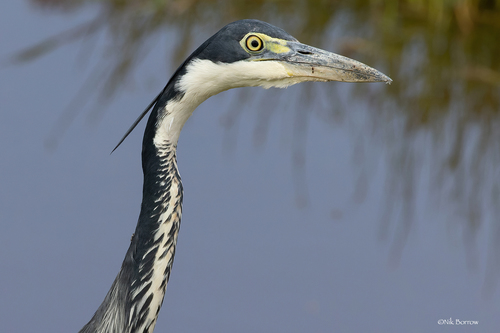
Black-headed Heron
Ardea melanocephala
The 'land heron' of Africa, this striking bird is just as comfortable stalking your garden lawn as it is a remote marshland. With its bold black-and-white plumage and piercing gaze, it is one of the most charismatic visitors to backyard cameras across the continent.
Quick Identification
Size
85–92 cm (33–36 in) tall with a 150 cm (59 in) wingspan; weighs approximately 1.1–1.5 kg (2.4–3.3 lbs).
Colors
Striking black crown and hindneck, white throat and foreneck, and slate-gray upperparts. Underwings are distinctively patterned in black and white.
Key Features
- Solid black crown and back of neck
- White throat contrasting with dark upperparts
- Large, spear-like yellowish bill
- Slow, rhythmic flight with retracted neck
When You’ll See Them
Sightings on EverydayEarth
May 14, 2026
A Black-headed Heron is perched prominently on a weathered branch. It spends the morning preening its slate-grey plumage and white throat feathers, occasionally turning its head to scan the surrounding woodland.
Jun 28, 2026
A Black-headed Heron is perched atop a dead, bleached tree branch, surveying the surrounding woodland. It remains mostly still, occasionally turning its head to scan for movement in the brush below.
Jun 27, 2026
A group of hippopotamuses is gathered in the middle of a watering hole, mostly submerged to stay cool under the morning sun. A Black-headed Heron stands perfectly still on a fallen log in the water, likely waiting for prey. The surrounding savanna and woodland remain quiet with no other large animals visible on the banks.
Jun 27, 2026
A group of hippos is resting in the watering hole, with only their backs and nostrils breaking the surface. A Black-headed Heron stands perfectly still on a partially submerged log in the middle-left of the pond, scanning the water for fish or amphibians.
Jun 27, 2026
A Black-headed Heron walks slowly through the tall grass on the left bank of the pond. In the center of the water, a pod of hippopotamuses is mostly submerged, with one individual seen twitching its ears. A Pied Kingfisher is perched on a partially submerged log, scanning the water for prey.
Jun 27, 2026
A bright daytime scene at a watering hole where a large pod of hippopotamuses is resting. Most are submerged, appearing as large gray mounds in the center of the water. A Black-headed Heron stands motionless on a rock in the foreground, while another bird is perched on a dead branch further to the left. The camera zooms out during the sequence to provide a wide view of the surrounding wooded savanna.
Geographic range
Where Does the Black-headed Heron Live?
Native to the African continent, the Black-headed Heron is a widespread resident throughout Sub-Saharan Africa and Madagascar. It thrives from the Cape in South Africa up through East Africa to the Sahel, with core populations concentrated in countries like Kenya, Nigeria, and South Africa. While they are primarily permanent residents, some populations perform seasonal movements to exploit the emergence of prey during rainy seasons in more arid regions.
Basemap © OpenStreetMap contributors
Recorded on EverydayEarth
Behavior
Unlike many of its relatives, the Black-headed Heron is a remarkably terrestrial hunter. While it will frequent water edges, it is just as likely to be seen stalking through dry grasslands, agricultural fields, or even suburban parks. It is a patient predator, often standing motionless for long periods before striking with lightning speed to impale its prey. This species is relatively bold and has adapted well to human presence, frequently using garden lawns as hunting grounds.
Socially, these herons are usually solitary when foraging but become highly communal during the breeding season. They nest in large, noisy colonies called heronries, often situated in tall trees within villages or cities. They are largely sedentary throughout their range, though some populations in West Africa follow the rains to find better feeding opportunities in the north during the wet season.
EverydayEarth exclusive
Camera Tips
To capture the Black-headed Heron on a backyard camera, placement is everything. These birds are 'stalkers' that prefer open ground with short grass where they can easily spot movement. Position your camera about 2 to 3 feet off the ground, angled slightly downward toward a clearing or a well-maintained lawn. Because they are tall, avoid placing the camera too low or you may only capture their legs; a wider angle is better for framing their full profile.
While they don't respond to traditional birdseed, they are highly attracted to areas with high rodent or insect activity. If you have a compost pile or an area of the garden that naturally attracts lizards and grasshoppers, this is an ideal spot for your camera. They are most active in the early morning and late afternoon, so ensure your camera is set to capture high-resolution triggers during these high-light periods to catch the detail in their black and grey plumage.
Using a PIR (Passive Infrared) sensor is highly effective for these birds because their slow, deliberate movements can sometimes fail to trigger basic video motion detection. Set your camera for a short burst of 3-5 photos followed by a 20-second video clip. This allows you to capture the initial strike—which is incredibly fast—as well as the fascinating 'gulping' behavior as they swallow their prey whole.
Similar Species
Species that look similar or are commonly confused with Black-headed Heron.
Frequently Asked Questions
Record Black-headed Heron at your habitat
Connect a camera to start building your own species record — AI identifies every visitor automatically.