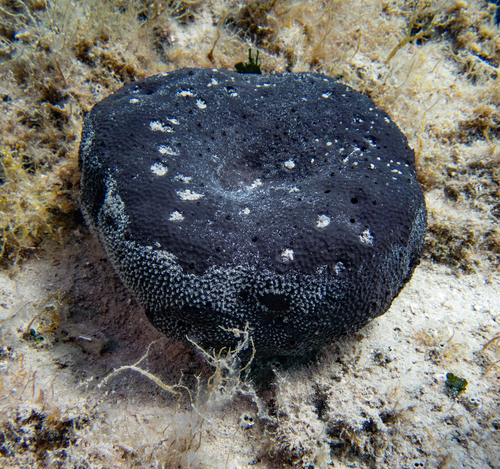
black leather sponge
Sarcotragus spinosulus
A resilient architect of the Mediterranean seafloor, the black leather sponge is more than just a stationary organism—it’s a living fortress. Known for its tough, dark exterior and its role as a micro-habitat, this sponge is a fascinating subject for any underwater explorer.
Quick Identification
Size
10-30 cm (4-12 inches) in diameter; 5-15 cm (2-6 inches) in height
Colors
Deep black to dark chocolate brown exterior; internal tissue is typically a lighter grey or tan
Key Features
- Tough, leathery skin-like surface
- Small, pointed cone-shaped bumps (conules) covering the surface
- Massive, irregular hemispherical shape
- Pungent, garlic-like odor when exposed to air
When You’ll See Them
Geographic range
Where Does the black leather sponge Live?
The black leather sponge is primarily native to the Mediterranean Sea and the temperate waters of the Eastern Atlantic Ocean. Its core range spans the coastal waters of Southern Europe, including the rocky shores of Spain, Italy, and Greece, and extends across to the North African coastline. In the Atlantic, it can be found from the Portuguese coast down toward Morocco and occasionally as far north as the Bay of Biscay.
Basemap © OpenStreetMap contributors
Behavior
The black leather sponge is a sessile marine organism, meaning it remains fixed to one spot for its entire adult life. Unlike many animals that hunt or forage, this sponge acts as a biological pump. It draws massive quantities of seawater through microscopic pores, filtering out nutrients and oxygen before expelling the waste water through larger, visible openings called oscula. This constant filtration makes it a vital component of the marine ecosystem, cleaning the water and concentrating nutrients.
While the sponge itself is stationary, it is a hub of social activity for other species. Its complex internal canal system and rugged, conulated exterior provide a safe haven for small crustaceans, worms, and brittle stars. These "tenants" live within the sponge's structure, often protected from larger predators by the sponge's tough, leathery texture and the chemical deterrents it produces to discourage grazing fish.
Interaction with humans is primarily limited to divers and snorkelers. Historically, sponges in the Sarcotragus genus were not harvested for commercial bathing use because their fibers (spongin) are too tough and often contain sand or debris, unlike the "soft" bath sponges. However, they are of great interest to the scientific community for the unique chemical compounds they produce, which are being studied for potential pharmaceutical applications.
EverydayEarth exclusive
Camera Tips
Capturing the black leather sponge on camera requires an underwater setup, such as a GoPro or a specialized marine housing for a trail camera. Because this species is sessile, you don't have to worry about it moving out of frame, but the challenge lies in its dark coloration. Black surfaces absorb light, so you will need powerful external underwater video lights to reveal the texture of the conules and the subtle ridges of its 'leathery' skin. Position your lights at a 45-degree angle to the side to create shadows that define its 3D structure; flat, head-on lighting will make it look like a featureless black blob.
For those monitoring coastal backyards with tidepools, look for this sponge in deeper, shaded crevices that remain submerged even at low tide. Mounting a camera using a heavy weighted base or a suction cup mount on a nearby flat rock is effective. Set your camera to time-lapse mode with a shot every 30 seconds to 1 minute. While the sponge won't move, you will capture the fascinating 'micro-wildlife' that visits it—look for small translucent shrimp or colorful nudibranchs that often crawl across the sponge's surface to feed or seek shelter.
Macro settings are your best friend when filming Sarcotragus spinosulus. Getting close allows you to see the oscula (exhalant pores) and the intricate surface detail. If your camera allows, use a high frame rate (60fps or higher) to capture the particulate matter in the water as it is sucked toward the sponge; this visually demonstrates the animal's filter-feeding behavior. Ensure your lens is clean and free of salt spots, as the dark background of the sponge will make any lens flare or debris highly visible.
Seasonality isn't a major factor for the sponge itself, but water clarity is. Plan your camera deployments for periods after several days of calm seas to avoid 'backscatter'—the reflection of light off suspended sand or silt. In late spring and summer, you are more likely to see symbiotic species interacting with the sponge, providing much more dynamic footage for your backyard wildlife collection.
Frequently Asked Questions
Record black leather sponge at your habitat
Connect a camera to start building your own species record — AI identifies every visitor automatically.