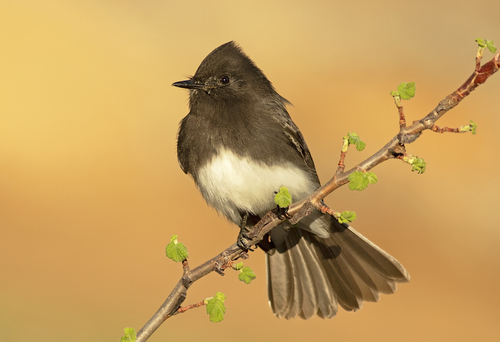
Black Phoebe
Sayornis nigricans
With its dapper 'tuxedo' plumage and rhythmic tail-wagging, the Black Phoebe is a beloved fixture of Western backyards. This acrobatic flycatcher is a master of the air, turning every fence post into a stage for its hunting displays.
Quick Identification
Size
Length: 15–18 cm (5.9–7.1 in); Wingspan: 27–28 cm (10.6–11 in); Weight: 15–22 g (0.5–0.8 oz)
Colors
Striking sooty black plumage across the head, chest, and back, with a crisp, starkly contrasting white belly and under-tail coverts. Males and females look identical.
Key Features
- Sharp contrast between charcoal-black chest and snow-white belly
- Frequent downward tail-pumping or wagging motion while perched
- Peaked or 'crested' appearance to the crown
- Short, thin black bill designed for snatching insects
When You’ll See Them
Geographic range
Where Does the Black Phoebe Live?
Native to the Western Hemisphere, the Black Phoebe is a quintessential bird of the American West and Southwest. Its core range begins in coastal Oregon and California, stretching across the Southwestern United States through Mexico and Central America. In South America, it follows the Andean corridor as far south as Northwest Argentina, typically remaining a permanent resident wherever it finds suitable water and nesting mud.
Basemap © OpenStreetMap contributors
Behavior
The Black Phoebe is a charismatic and highly visible flycatcher, often seen perched on low branches, fences, or rocks near water. It is best known for its 'sallying' foraging style, where it sits motionless—save for its characteristic tail-wagging—before darting into the air to snatch an insect mid-flight with an audible snap of its bill. Unlike many other flycatchers that hide in dense foliage, the Black Phoebe prefers open vistas where it can keep a watchful eye on its territory.
These birds are remarkably bold around humans and have adapted well to suburban life. They are often found nesting under the eaves of houses, on bridges, or near backyard fountains. While they are generally solitary or found in pairs during the breeding season, they do not form large flocks. They are fiercely territorial of their foraging spots and will often return to the exact same 'launching perch' day after day.
EverydayEarth exclusive
Camera Tips
To capture the best footage of a Black Phoebe, focus your camera on 'launch pads' rather than feeders. Because they don't eat seeds, traditional bird feeder setups won't work. Look for a prominent, low-hanging branch, a fence post, or the edge of a birdbath where the bird repeatedly returns after hunting. Position your camera about 3 to 5 feet away from this perch, angled slightly upward to capture the bird's white belly and tail-wagging behavior against the sky or a neutral background.
Since these birds are drawn to water, placing a camera near a fountain or a shallow pond is highly effective. They not only drink and bathe there but also hunt the gnats and flies that congregate near the water. If you have an AI-powered camera with a high frame rate, use it; the Black Phoebe’s flight is incredibly fast, and a standard 15fps camera might only catch a blur as they sally forth to grab a meal.
During the spring, look for mud. Black Phoebes build cup-shaped nests out of mud pellets and grass, often plastered against vertical surfaces like the walls of a porch or under a bridge. If you see a phoebe hovering near a muddy patch in your garden, it’s likely gathering nesting material. Setting your camera to a 'high sensitivity' motion trigger near these mud sources can yield fascinating videos of their architectural process. Ensure your camera is set to record for at least 20-30 seconds to capture the full sequence of them landing, gathering mud, and taking off.
Similar Species
Species that look similar or are commonly confused with Black Phoebe.
Say's Phoebe
Lacks the crisp black-and-white contrast; features a grayish-brown back and a warm cinnamon-orange belly.
Eastern Phoebe
Found further east; has an olive-brown back and a yellowish-white belly without the stark black chest.
Dark-eyed Junco
Similar color palette but has a thick seed-eater bill, hops on the ground rather than fly-catching, and lacks the tail-pumping habit.
Frequently Asked Questions
Record Black Phoebe at your habitat
Connect a camera to start building your own species record — AI identifies every visitor automatically.