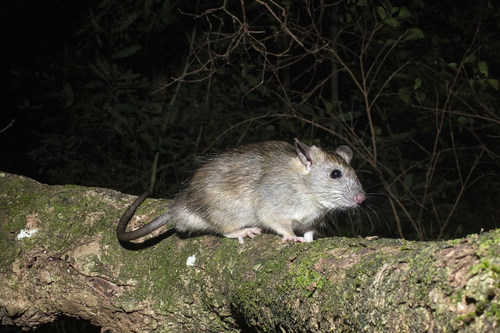
Black Rat
Rattus rattus
The ultimate high-wire artist of the backyard, the Black Rat is a master of climbing and stealth. Discover the secret life of this globally successful traveler as it navigates the elevated pathways of your home.
Quick Identification
Size
Head-body length of 16–24 cm (6–9 in) with a tail of 18–26 cm (7–10 in); weights 150–250 g (5–9 oz).
Colors
Typically charcoal black to greyish-brown with a slightly lighter belly. The tail is uniformly dark and scaly.
Key Features
- Tail is significantly longer than the combined length of the head and body
- Large, thin, hairless ears that can reach the eyes when folded forward
- Pointed snout and large, dark, protruding eyes
- Slender, agile build compared to other rat species
When You’ll See Them
Geographic range
Where Does the Black Rat Live?
Originally hailing from the Indian subcontinent and Southeast Asia, the Black Rat has used international shipping routes to become one of the most widely distributed mammals on the planet. They are established on every continent except Antarctica, with particularly dense populations in coastal regions of the United States, the United Kingdom, Australia, and throughout tropical Asia and Africa. While they have been pushed out of some inland temperate regions by the larger Brown Rat, they remain the dominant species in warmer climates and coastal port cities.
Basemap © OpenStreetMap contributors
Behavior
The Black Rat, also known as the Roof Rat, is a highly agile and intelligent rodent known for its exceptional climbing abilities. Unlike many other rodents, this species is semi-arboreal and prefers to live high off the ground. They are frequently found nesting in attics, rafters, or the dense canopies of trees, using power lines and fence tops as elevated highways to navigate their territory without ever touching the soil.
These rodents are primarily nocturnal and live in social groups often led by a dominant male. They are famously neophobic, exhibiting an extreme caution toward new objects or changes in their environment. This cautious nature makes them a fascinating subject for backyard observation, as they will often spend several nights investigating a new camera setup before becoming comfortable enough to linger in front of the lens.
EverydayEarth exclusive
Camera Tips
To successfully capture the Black Rat on camera, you must think vertically. These rats are the acrobats of the rodent world and spend very little time on the ground. Position your AI-powered camera along elevated pathways such as the top rail of a fence, a thick tree branch leading toward a roof, or even secured to a rafter in an outbuilding. Mounting the camera 5 to 10 feet high, angled slightly downward toward a known 'runway,' is the most effective way to catch them.
Because Black Rats are neophobic—meaning they are afraid of new things—you should place your camera and leave it turned off for 3–4 days. This allows the rats to get used to its presence. When you are ready to record, use highly aromatic baits like peanut butter, sliced apples, or birdseed mixed with honey. Smear a small amount of the bait directly onto the surface of the branch or fence rail within the camera's focal point to encourage the rat to stop and groom or eat, rather than just scurrying past.
Fast shutter speeds and high-quality infrared (IR) settings are crucial since these animals are strictly nocturnal and move very quickly. If your camera supports video, set it to 10–15 second clips. This will allow you to see their amazing climbing techniques and the way they use their long tails for balance while navigating narrow ledges. Look for 'grease marks'—dark, oily stains left by their fur on wood or pipes—to identify the best spots for camera placement.
Similar Species
Species that look similar or are commonly confused with Black Rat.
Frequently Asked Questions
Record Black Rat at your habitat
Connect a camera to start building your own species record — AI identifies every visitor automatically.