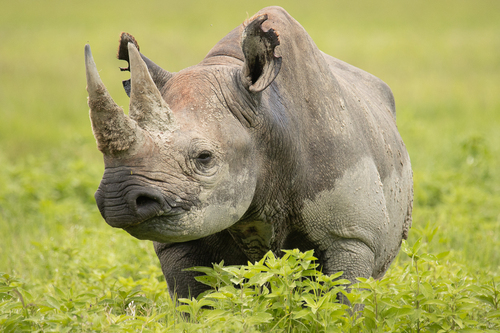
Black Rhinoceros
Diceros bicornis
The black rhinoceros is the elusive, hooked-lipped architect of the African bush. A prehistoric marvel, this critically endangered browser is known for its incredible power, surprising agility, and a solitary nature that makes every sighting a rare privilege.
Quick Identification
Size
Weight: 800-1,400 kg (1,760-3,080 lbs); Height: 1.4-1.8 m (4.5-6 ft); Length: 3-3.75 m (10-12.5 ft)
Colors
Typically slate grey to dark brown; skin color is often influenced by the color of the mud or dust they wallow in. Males and females look identical.
Key Features
- Pointed, prehensile (hooked) upper lip
- Two horns on the snout, with the front horn significantly longer
- Small, rounded ears and a concave back profile
- Compact, stocky build compared to the white rhino
When You’ll See Them
Sightings on EverydayEarth
Jun 25, 2026
A Black Rhinoceros is foraging in the foreground, using its prehensile lip to investigate the ground. In the background, a small nocturnal mammal is seen briefly moving through the shadows near the fence line.
Jun 22, 2026
A rhinoceros stands quietly under the cover of a tree at night, occasionally flicking its tail. A second individual is partially visible in the deep shadows to the right, indicated by its eye shine. Toward the end of the sequence, the foreground rhino begins to walk slowly across the open, sandy ground.
Jun 20, 2026
A black rhinoceros walks across the dusty, reddish-brown earth of its enclosure. It pauses for a moment near a small tree on the left, sniffing the ground before continuing its path and moving out of the camera's view.
Jun 18, 2026
Two young rhinoceroses are lying on the dusty ground in a woodland clearing at night. They are resting peacefully, with the individual on the right positioned with its head clearly visible, while the one on the left has its back to the camera.
Jun 17, 2026
Two rhinoceroses are resting on the sandy ground during the night. The rhino in the foreground twitches its ears occasionally while sleeping. Nearby, an Egyptian goose sits huddled on the ground, remaining mostly still.
Jun 17, 2026
A Black Rhinoceros slowly traverses the sandy clearing at night, occasionally lowering its head to sniff the ground. In the background, a small mammal stands still and alert near the base of a tree, while a stationary object resembling a tortoise sits nearby.
Geographic range
Where Does the Black Rhinoceros Live?
Native to the African continent, the Black Rhinoceros is found in fragmented populations across East and Southern Africa. Their core strongholds today are primarily located within South Africa, Namibia, Kenya, and Zimbabwe, with ongoing reintroduction efforts expanding their presence into protected areas in Botswana, Rwanda, and Malawi. These giants thrive in semi-arid regions and scrub forests where they can find the dense vegetation necessary for both food and concealment.
Basemap © OpenStreetMap contributors
Behavior
Black rhinos are famously solitary and more high-strung than their white rhino relatives. They are known for being territorial and can be surprisingly aggressive if they feel threatened, often charging at perceived intruders or unfamiliar scents. Because of their poor eyesight, they rely heavily on their acute sense of hearing and smell to navigate their environment and detect danger from long distances.
Communication occurs through scent marking, where individuals create dung middens to signal their presence to others, and a variety of vocalizations including snorts, growls, and trumpet-like calls. They are highly agile for their size, capable of navigating dense thickets and reaching speeds of up to 55 km/h (34 mph) when charging or fleeing.
EverydayEarth exclusive
Camera Tips
To successfully capture a black rhino on camera, placement is everything. Unlike grazing animals that stay in the open, black rhinos move through thickets. Look for 'rhino tunnels'—distinct paths pushed through dense brush—or communal dung middens. Position your camera at a height of about 1.2 meters (4 feet) and ensure it is secured with a heavy-duty steel security box. These animals are powerful and curious; they may nudge or rub against your setup, so a flimsy mount will not suffice.
Water sources are the ultimate hotspots for activity. Black rhinos visit water holes not just to drink, but to wallow in mud, which helps regulate their temperature and protects their skin from parasites. Set your camera to capture short video clips (15-20 seconds) rather than just photos. This allows you to witness their unique social behaviors, such as the 'fencing' of horns or the interactions between a mother and her calf, which often occur during the cooler twilight hours.
Because black rhinos are incredibly sensitive to scent, always approach your camera site from downwind during setup and minimize the time you spend at the location. Use a high-quality infrared flash rather than a white flash to avoid spooking them; a sudden bright light in the dark can trigger a defensive charge. Check your local regulations regarding trail cameras in rhino territory, as many conservation areas have specific rules to protect these animals from poachers who might use metadata to track them.
Similar Species
Species that look similar or are commonly confused with Black Rhinoceros.
Frequently Asked Questions
Record Black Rhinoceros at your habitat
Connect a camera to start building your own species record — AI identifies every visitor automatically.