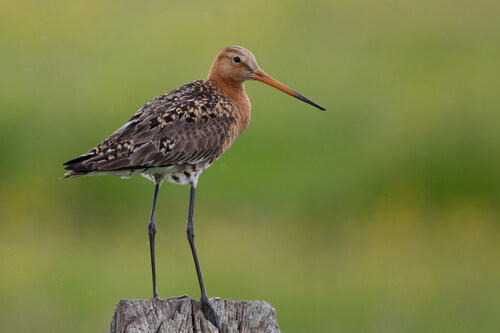
Black-tailed Godwit
Limosa limosa
A master of migration and a symbol of the wetlands, the Black-tailed Godwit stands tall on stilt-like legs. Witness the elegance of this orange-breasted traveler as it probes the earth with its signature long bill.
Quick Identification
Size
Length 37–44 cm (14.5–17.3 in), wingspan 63–75 cm (24.8–29.5 in), weight 250–500 g (8.8–17.6 oz)
Colors
Breeding adults have a bright orange-cinnamon head, neck, and breast with barred underparts. In winter, they turn a uniform grey-brown. Both sexes show a bold white wingbar and black tail in flight.
Key Features
- Extraordinarily long, straight orange-based bill
- Bold white wingbars visible during flight
- Long dark legs that extend well past the tail in flight
- Distinctive black terminal band on a white tail
When You’ll See Them
Geographic range
Where Does the Black-tailed Godwit Live?
The Black-tailed Godwit is a true globe-trotter native to the Palearctic, with breeding grounds stretching from Iceland and the United Kingdom across Central Europe and Central Asia all the way to Siberia. As a migratory specialist, it travels south for the winter to the warmer shores of sub-Saharan Africa, the Mediterranean basin, the Indian subcontinent, and Southeast Asia down to Australia. While it is a rare visitor to North America, its presence is a vital indicator of wetland health across the Eurasian and Afro-Eurasian flyways.
Basemap © OpenStreetMap contributors
Behavior
The Black-tailed Godwit is a highly social and charismatic shorebird, often seen in large, noisy flocks during the non-breeding season. They are famous for their elegant, long-legged stride and their specialized feeding technique, which involves probing their long bills deep into soft mud with a sewing-machine-like motion. During the spring, males perform breathtaking 'song-flights,' tossing themselves through the air with rolling calls to defend their nesting territories in damp grasslands.
While they are wary of direct human contact, they have adapted to agricultural landscapes, frequently using flooded rice fields and cow pastures as stopover points. Their social nature means that if you spot one, there are likely many more nearby. They communicate with a variety of 'wicka-wicka-wicka' calls that are a staple sound of European and Asian wetlands.
EverydayEarth exclusive
Camera Tips
To capture high-quality footage of a Black-tailed Godwit, your camera placement is critical. These birds are 'probers,' so you should position your AI camera near soft, wet mud at the edge of a pond, marsh, or flooded field. Set the camera on a low tripod or ground spike only 10-15 inches above the surface. This 'low-angle' perspective provides a much more intimate view of the bird's face and bill as it feeds, rather than a top-down shot that loses the bird's profile.
Because godwits are easily spooked by sudden movements, use a camera with a high-quality PIR sensor and place it in a spot with minimal tall grass that might trigger 'false positives' in the wind. They are most active in the golden hours of early morning and late afternoon; the soft light at these times will beautifully catch the orange tones of their breeding plumage. If you are monitoring a backyard wetland, ensure the water level stays shallow (less than 4 inches) to keep the muddy bottom within reach of their bills.
Avoid using food baits, as these birds are specialized hunters of live invertebrates. Instead, focus on habitat 'lures' like keeping a patch of mud clear of thick vegetation. During the spring migration, set your camera's video length to at least 20-30 seconds—this will allow you to capture their fascinating social interactions and the rhythmic 'sewing machine' probing behavior that defines the species.
Similar Species
Species that look similar or are commonly confused with Black-tailed Godwit.
Frequently Asked Questions
Record Black-tailed Godwit at your habitat
Connect a camera to start building your own species record — AI identifies every visitor automatically.