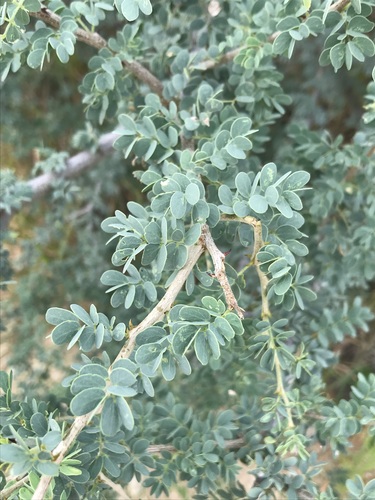
Black thorn
Senegalia mellifera
A masterpiece of dryland survival, the Black thorn is celebrated for its intoxicating honey-scented flowers and feared for its 'wait-a-bit' hooked thorns. It serves as a vital sanctuary for birds and pollinators across the African savanna.
Quick Identification
Size
Typically 5-9 meters (16-30 feet) tall, often with a multi-stemmed, shrub-like habit.
Colors
Ash-grey bark on young branches, turning dark grey to black with age; cream to white flower spikes; dark brown seed pods.
Key Features
- Paired, black, hooked thorns (swarthaak)
- Cream-white spherical or spike-like flower clusters with a honey scent
- Small, rounded leaflets in two pairs
- Multi-stemmed growth forming dense thickets
When You’ll See Them
Geographic range
Where Does the Black thorn Live?
The Black thorn is a signature species of the African continent, natively spanning from the arid regions of Egypt and Ethiopia in the northeast down through East Africa into the southern reaches of the continent. It is particularly dominant in the Kalahari and across the landscapes of Namibia, Botswana, and South Africa, where it thrives in the dry, sun-drenched savannas. While primarily native to Africa, it is also found across the Arabian Peninsula, marking it as a truly hardy specialist of the world's desert-fringe environments.
Basemap © OpenStreetMap contributors
Behavior
The Black thorn, known scientifically as Senegalia mellifera, is a resilient and aggressive pioneer species often associated with bush encroachment in overgrazed areas. It is famous for its 'honey-bearing' blossoms (mellifera means 'honey-bearing' in Latin) that emit a powerful, sweet fragrance during the spring, attracting a massive diversity of pollinators including bees, butterflies, and beetles. This biological activity creates a micro-ecosystem around the tree, making it a hub for insectivorous birds and small mammals.
In the wild, the Black thorn provides essential security. Its dense, hooked thorns—which curve backward—act like biological barbed wire, creating impenetrable thickets where small animals can hide from larger predators. Humans have long valued the tree for its extremely hard wood; when treated with oil, the timber turns a deep, lustrous black, which is why it is often used for high-quality tool handles and ornamental carvings.
EverydayEarth exclusive
Camera Tips
When using an AI-powered camera to monitor a Black thorn, think of the tree as a natural 'safe house' for wildlife. Mount your camera about 1 to 1.5 meters (3-5 feet) off the ground, angled toward the lower interior branches. This is where small mammals like mongooses, genets, and even porcupines tend to scurry for cover. The complex branch structure can sometimes trigger false motion alerts in high winds, so try to mask out thin, swaying outer twigs in your camera’s detection zones.
During the flowering months of late winter and spring, the tree becomes a magnet for avian life. To capture the best bird activity, position your camera with a clear view of the flower spikes on the outer canopy. Because the flowers are bright white or cream, they can easily overexpose in midday sun; if your camera allows, slightly decrease the exposure compensation or ensure the sun is behind the camera to get the best color saturation on visiting sunbirds and honeybees.
At night, the Black thorn's dark bark absorbs a significant amount of infrared light. If you are targeting nocturnal visitors like bushbabies or owls that frequent the tree, set your camera's IR flash to its maximum range. If you notice that the white flowers are 'blowing out' at night, try moving the camera back a few feet to allow the flash to spread more evenly across the foliage. Placing a shallow water dish near the base of the tree is an excellent way to create a high-traffic zone, as animals will use the tree’s thorns as a protective screen while they drink.
Similar Species
Species that look similar or are commonly confused with Black thorn.
Frequently Asked Questions
Record Black thorn at your habitat
Connect a camera to start building your own species record — AI identifies every visitor automatically.