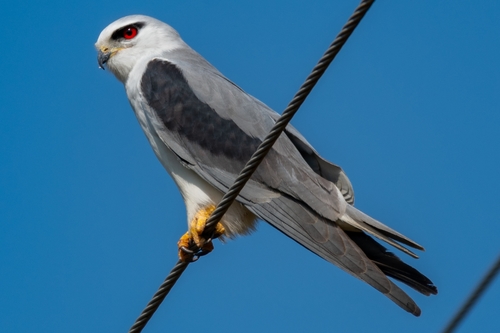
Black-winged Kite
Elanus caeruleus
A ghostly white hunter with piercing ruby eyes, the Black-winged Kite is the master of the hover. Watch this nomadic raptor patrol the grasslands with an owl-like gaze and surgical precision.
Quick Identification
Size
Length of 31-35 cm (12-14 in), wingspan of 75-80 cm (30-31 in), and weight between 200-300 g (7-11 oz)
Colors
Striking white and pale grey plumage with bold black patches on the wing coverts (shoulders); adults feature iconic ruby-red irises.
Key Features
- Vivid ruby-red eyes set in a subtle black mask
- Prominent black 'shoulder' patches on grey wings
- Short, square-tipped white tail
- Frequent hovering flight pattern while hunting
When You’ll See Them
Geographic range
Where Does the Black-winged Kite Live?
This elegant raptor is primarily native to the vast landscapes of sub-Saharan Africa and tropical Asia. However, it is an incredible success story of range expansion, having firmly established itself across the Iberian Peninsula in Spain and Portugal, and more recently moving into Southwest France. It thrives in open-country environments, from semi-deserts to agricultural plains, wherever tall grass provides cover for its rodent prey.
Basemap © OpenStreetMap contributors
Behavior
The Black-winged Kite is a sophisticated hunter known for its kestrel-like ability to hover effortlessly over open ground. By facing into the wind and using rapid, shallow wingbeats, it keeps its head perfectly still to lock onto the slightest movement in the grass below. Once prey is spotted, it descends in a controlled, vertical drop with wings held high in a 'V' shape, a maneuver known as a 'parachute' drop.
Unlike many other raptors that are strictly territorial, these kites are notably nomadic. They follow 'rodent outbreaks,' appearing in large numbers where mice or voles are plentiful and moving on once the food source thins out. They are generally quiet birds, but they possess an owl-like quality due to their forward-facing eyes and soft plumage, which allows for relatively silent flight during their preferred hunting times at dawn and dusk.
EverydayEarth exclusive
Camera Tips
To capture the Black-winged Kite on a trail camera, you must think vertically. These birds rarely spend time on the ground except during the final seconds of a strike. The best placement for your camera is 6 to 10 feet high, mounted on a pole or tree overlooking a lone, prominent perch. Look for 'scout perches'—isolated dead branches or fence posts on the edge of a field—where the bird sits to scan for prey. Angling the camera slightly upward to capture the bird as it lands will yield the best profile shots.
Because these kites are highly visual, baiting is ineffective and often attracts scavengers that might damage your gear. Instead, focus on habitat. If your property lacks natural perches, you can create a 'camera trap' by installing a 2-meter tall T-post with a horizontal wooden crossbar in the middle of an open field. Place your AI-powered camera 3 to 4 meters away, facing the perch. This species is remarkably tolerant of human structures and will likely adopt your man-made perch within days if it is the highest point in the immediate area.
Lighting and settings are your biggest challenges. The Black-winged Kite’s plumage is brilliantly white, which can easily lead to 'blown out' images where all detail is lost in a white blur. Set your camera’s exposure compensation to -0.5 or -1.0 if possible. Use a high-speed trigger and burst mode; the moment they take flight, they reveal their namesake black wing patches, which are often hidden while they are perched. Since they are most active during the golden hours, ensure your camera has high-quality low-light sensors to capture the vivid red of their eyes without graininess.
Similar Species
Species that look similar or are commonly confused with Black-winged Kite.
Frequently Asked Questions
Record Black-winged Kite at your habitat
Connect a camera to start building your own species record — AI identifies every visitor automatically.