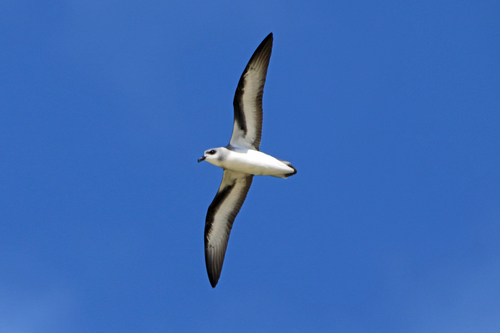
Black-winged Petrel
Pterodroma nigripennis
An acrobatic master of the Pacific winds, the Black-winged Petrel is famous for its high-speed 'rollercoaster' flight and striking underwing patterns. These resilient seabirds travel thousands of miles across the open ocean, returning to remote islands only to raise the next generation in hidden forest burrows.
Quick Identification
Size
Length: 29-31 cm (11.5-12 in); Wingspan: 63-71 cm (25-28 in); Weight: 145-200 g (5.1-7.1 oz)
Colors
Pale grey upperparts with a dark 'M' pattern; white underparts with a distinctive black border on the leading edge of the underwing; white face with a dark patch around the eye.
Key Features
- Distinctive black margin on the underwing leading edge
- Dark 'M' or 'W' pattern across grey wings and back
- Short, stout black bill with a hooked tip
- High, banking, acrobatic flight style
When You’ll See Them
Geographic range
Where Does the Black-winged Petrel Live?
The Black-winged Petrel is native to the Pacific Ocean, with its primary breeding grounds located on remote islands in the Southwest Pacific, including Lord Howe Island, Norfolk Island, and the Kermadec Islands. In recent decades, its range has expanded significantly to include several islands off the coast of New South Wales and even New Caledonia. During the non-breeding season, these birds migrate across the equator into the North Pacific, frequently reaching the waters around Hawaii and occasionally being sighted off the western coast of North America and Japan. This expansive range makes them one of the most widely dispersed gadfly petrels in the Pacific basin.
Basemap © OpenStreetMap contributors
Behavior
During the breeding season, these petrels become semi-nocturnal at their nesting colonies to avoid predators like gulls or hawks. They are highly social near their burrows, often seen in 'aerial displays' where groups circle and call to one another in a high-pitched 'ti-ti-ti' chatter. Unlike some other petrels, they are relatively bold and can sometimes be seen arriving at their colonies in the late afternoon before the sun has fully set.
While they are solitary foragers at sea, they are not particularly shy of ships and may occasionally follow vessels, though they do not typically scavenge like some albatross species. Their interactions with humans are limited to their breeding islands, where they are sensitive to habitat disturbance and introduced predators.
EverydayEarth exclusive
Camera Tips
Capturing a Black-winged Petrel on camera is a specialized task because they are almost never seen on the ground outside of their breeding colonies. If you live in or are visiting a coastal or island region where they nest, place your camera near the entrance of known burrows in sandy soil or under forest leaf litter. Use a low tripod or a ground mount, angling the camera slightly upward to capture the bird as it lands or enters the burrow. Because they are clumsy on land, they often pause briefly before disappearing underground, giving you a perfect window for a shot.
Since these birds are most active at the colonies from late afternoon through the night, a camera with high-quality Infrared (IR) night vision is essential. To avoid 'white-out'—where the bird's white underbelly reflects too much IR light and loses detail—set your camera's IR intensity to 'medium' or 'low' if the burrow is within 5 feet. A fast trigger speed (0.3s or less) is vital because petrels can move surprisingly quickly when they decide to scuttle into their holes.
If you are trying to capture their spectacular flight from a coastal vantage point, use a camera with a high frame rate or 'burst mode.' Position the camera facing into the wind, as these birds utilize head-winds to gain lift and perform their characteristic high-arching banks. Avoid using flash, as it can disorient the birds and potentially lead to collisions with trees or rocks. Instead, rely on the camera's low-light sensors during the 'golden hour' just before sunset when the birds begin to congregate over the island.
Similar Species
Species that look similar or are commonly confused with Black-winged Petrel.
Frequently Asked Questions
Record Black-winged Petrel at your habitat
Connect a camera to start building your own species record — AI identifies every visitor automatically.