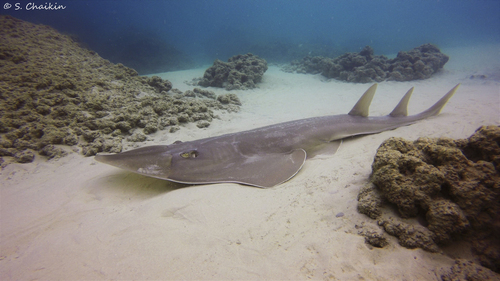
Blackchin Guitarfish
Glaucostegus cemiculus
The ghost of the seabed, the Blackchin Guitarfish is a master of camouflage that bridges the gap between sharks and rays. Now critically endangered, this stunning 'rhino fish' is a rare prize for any coastal wildlife observer.
Quick Identification
Size
Total length up to 2.4 metres (7.9 feet); commonly 1.5–2.0 metres (5–6.5 feet). Weights can reach 50 kg (110 lbs).
Colors
Uniform sandy brown or yellowish-grey upper side; creamy white underside. A prominent blackish-brown spot is located on the underside of the snout.
Key Features
- Broadly triangular, pointed snout with a distinct black smudge underneath
- Two large, triangular dorsal fins located well behind the pelvic fins
- Flattened head and pectoral fins resembling a ray, with a thick, shark-like tail
- Small, granular teeth arranged in pavement-like rows for crushing shells
When You’ll See Them
Geographic range
Where Does the Blackchin Guitarfish Live?
Native to the eastern Atlantic Ocean and the Mediterranean Sea, the Blackchin Guitarfish is a coastal specialist of the Old World. Its core range extends from the northern shores of the Mediterranean, through the Strait of Gibraltar, and down the West African coastline as far south as Angola. While once common throughout the Mediterranean, its current stronghold is primarily within the warmer waters of the West African continental shelf.
Basemap © OpenStreetMap contributors
Behavior
Socially, these fish are generally solitary but are known to congregate in shallow coastal lagoons and estuaries during the late spring and summer months for breeding. Unlike many other fish, they do not lay eggs in the open water; instead, they are ovoviviparous, giving birth to 4–10 live young after the embryos develop inside the mother. They are completely harmless to humans unless provoked, though their declining numbers mean encounters are becoming increasingly rare for coastal residents.
EverydayEarth exclusive
Camera Tips
Strategic placement is better than luck; look for 'sand highways'—clear patches of sand located between seagrass beds or rocky outcrops. These are natural corridors for guitarfish. While they don't respond to traditional bird-style feeders, you can use an 'attractor' by securing a mesh bag filled with crushed crabs or oily fish scraps (like sardines) about three feet in front of the camera. The scent will lure them into the frame without obscuring the view with a bulky bait box.
Because the Blackchin Guitarfish is most active during crepuscular hours (dawn and dusk), ensure your camera has high dynamic range (HDR) settings enabled to handle the shifting light filtering through the water. If recording at night, use infrared (IR) lighting rather than white light, as bright flashes can spook these sensitive elasmobranchs. Set your device to record 30-second video clips rather than stills; their movement is often the only way to distinguish them from the sandy background due to their incredible camouflage.
Similar Species
Species that look similar or are commonly confused with Blackchin Guitarfish.
Frequently Asked Questions
Record Blackchin Guitarfish at your habitat
Connect a camera to start building your own species record — AI identifies every visitor automatically.