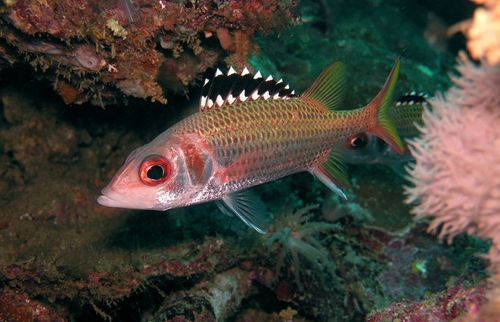
Blackfin Squirrelfish
Neoniphon opercularis
A master of the night, the Blackfin Squirrelfish is a shimmering jewel of the Indo-Pacific reefs. With its oversized eyes and striking black-tipped fin, it brings a touch of mystery to every coral crevice.
Quick Identification
Size
20–35 cm (8–14 inches); up to 0.5 kg (1.1 lbs)
Colors
Silvery-pink to reddish body with iridescent horizontal stripes; distinctive large black blotch on the anterior spiny dorsal fin.
Key Features
- Large, jet-black marking on the front of the dorsal fin
- Big, dark eyes optimized for nocturnal hunting
- Sharp venomous spine on the corner of the cheek (preopercle)
- Shimmering silver-red scales with dark edges
When You’ll See Them
Geographic range
Where Does the Blackfin Squirrelfish Live?
The Blackfin Squirrelfish is a widespread resident of the tropical Indo-Pacific region, flourishing in warm, clear coastal waters. Its native range begins along the eastern coast of Africa and the Red Sea, stretching across the Indian Ocean to the islands of the Maldives and Seychelles. It is commonly found throughout the Indo-Australian Archipelago, reaching as far north as the Ryukyu Islands of Japan and as far east into the Pacific as New Caledonia and the Marshall Islands.
Basemap © OpenStreetMap contributors
Behavior
The Blackfin Squirrelfish is a primarily nocturnal reef inhabitant that spends its daylight hours in a state of cautious rest. You will typically find them hovering motionless or swimming slowly within the dark recesses of coral caves, under ledges, or inside shipwrecks. While they can be solitary, they are frequently seen in small, loose-knit groups, staying close to the safety of the reef structure to avoid larger predators like groupers.
When night falls, this species undergoes a behavioral shift, becoming a bold and active hunter. They emerge from their shelters to patrol the reef flats and sandy lagoon bottoms in search of food. They are known for their defensive displays; if a diver or predator approaches too closely, the squirrelfish will quickly erect its spiny dorsal fin to appear larger and more formidable. Though generally shy, they are curious enough to occasionally investigate stationary objects in their environment, making them excellent subjects for patient underwater observers.
EverydayEarth exclusive
Camera Tips
To successfully capture the Blackfin Squirrelfish on an AI-powered underwater camera, placement is everything. These fish are 'structure-oriented,' meaning they rarely venture far into open water. Position your camera near 'bommies' (coral heads) or limestone overhangs that offer plenty of shadows. Mounting the camera on a weighted base about 30 centimeters off the sandy bottom, angled slightly upward toward the reef structure, will provide the best perspective to see their characteristic dorsal fin and large eyes.
Since this species is most active at night, your camera's low-light capabilities are critical. Use a system with a high-sensitivity 'starlight' sensor. If you use artificial lighting, opt for a red-light or infrared (IR) filter. White light often startles squirrelfish, causing them to retreat into deep crevices where the camera can't follow. Red light is less visible to them and will allow you to record their natural foraging and social behaviors without causing stress or flight.
Patience is key for reef-based cameras. Set your trigger sensitivity to high, as the silver scales of the Blackfin Squirrelfish can cause significant glinting that may trick some motion sensors. In tropical environments, biofouling is a major issue; ensure you or a diver cleans the lens cover every 48–72 hours to prevent algae growth from blurring the image. If the camera is in a lagoon with tidal currents, ensure it is heavily weighted or tethered to a fixed rock to prevent the 'swaying' motion that can lead to false triggers.
Similar Species
Species that look similar or are commonly confused with Blackfin Squirrelfish.
Frequently Asked Questions
Record Blackfin Squirrelfish at your habitat
Connect a camera to start building your own species record — AI identifies every visitor automatically.