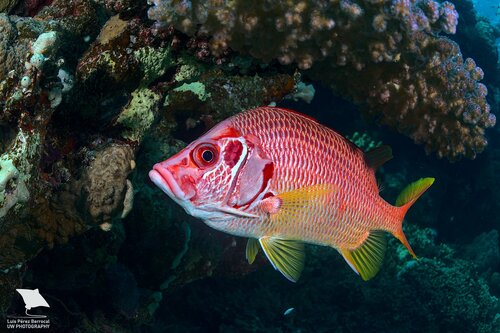
Sabre Squirrelfish
Sargocentron spiniferum
The undisputed giant of the squirrelfish family, the Sabre Squirrelfish is a crimson sentinel of the reef. With its formidable cheek spine and large, soulful eyes, it is a masterpiece of nocturnal evolution.
Quick Identification
Size
A large species reaching up to 45–51 cm (18–20 inches) and weighing up to 2.6 kg (5.7 lbs).
Colors
Brilliant scarlet to orange-red body with silver-edged scales; a distinctive dark red or blackish blotch is located on the upper gill cover.
Key Features
- Distinctive dark red blotch on the upper operculum
- Large, sharp spine on the lower cheek (the 'sabre')
- Vibrant red fins with yellow-tinged membranes
- Massive eyes adapted for low-light hunting
When You’ll See Them
Geographic range
Where Does the Sabre Squirrelfish Live?
The Sabre Squirrelfish is a quintessential Indo-Pacific resident, boasting a massive range that spans from the warm waters of the Red Sea and East Africa all the way to the Hawaiian Islands and Pitcairn. These striking fish are commonly spotted across the central Pacific, including the Great Barrier Reef in Australia, the Philippines, and the southern islands of Japan. While they are strictly tropical dwellers, their presence across such a vast oceanic territory makes them a staple of coral reef biodiversity in both the Indian and Pacific Oceans.
Basemap © OpenStreetMap contributors
Behavior
The Sabre Squirrelfish is the largest member of its family, acting as a dominant nocturnal predator within reef ecosystems. During the day, it is a shy and solitary creature, usually found hovering motionless deep inside caves, under large coral table formations, or within dark crevices. Unlike some smaller squirrelfish that may group together, the Sabre Squirrelfish is highly territorial and will defend its preferred daytime hiding spot from intruders.
As the sun sets, this species undergoes a behavioral shift, emerging from the shadows to hunt. While they are solitary hunters, they can be quite bold at night and are less likely to flee immediately from a light source than they are during the day. Their movements are slow and deliberate as they patrol the reef floor, using their large, light-sensitive eyes to detect the movement of prey in the darkness. To humans, they are generally wary but often become a familiar sight for night divers who frequent the same reef sections.
EverydayEarth exclusive
Camera Tips
To capture the Sabre Squirrelfish on an underwater AI-powered camera, placement is everything. These fish are creatures of habit; identify a prominent coral cave or a deep ledge during the day and position your camera nearby. The best angle is slightly low, looking toward the entrance of a crevice, as this fish often hovers near the threshold just after dusk before heading out to deeper water to forage.
Because they are strictly nocturnal, you will need an external light source. However, Sabre Squirrelfish are sensitive to sudden bright white light. If your camera setup allows it, use a red light filter for the motion trigger or focus assist. AI cameras should be set to a high-sensitivity motion trigger to capture the slow, gliding movement they exhibit when emerging from their dens. For the best clarity, ensure the camera is weighted securely to the seabed or a dead coral structure to avoid 'current blur' during long-exposure night shots.
If you are setting a stationary trail-style underwater camera, consider the 'bait and wait' strategy. While they are hunters, the scent of crushed crab or shrimp placed in a perforated container near the camera's field of view can lure them into the perfect frame. Ensure the bait is secured so that larger scavengers don't drag it out of the camera's range. Since these fish are year-round residents, any season is a good time for filming, provided the water clarity is high.
Similar Species
Species that look similar or are commonly confused with Sabre Squirrelfish.
Frequently Asked Questions
Record Sabre Squirrelfish at your habitat
Connect a camera to start building your own species record — AI identifies every visitor automatically.