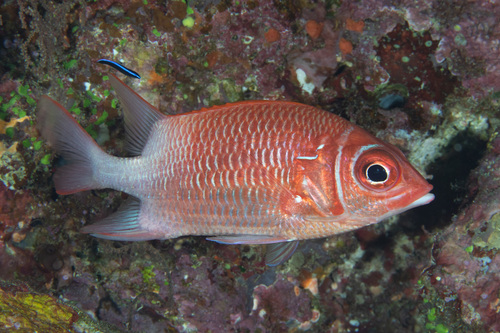
Tailspot Squirrelfish
Sargocentron caudimaculatum
A ruby-red master of the nocturnal reef, the Tailspot Squirrelfish is easily identified by its oversized eyes and the shimmering white 'tail light' that gives it its name. Hidden by day in coral shadows, it emerges under the moon to roam the Indian and Pacific Oceans.
Quick Identification
Size
18-25 cm (7-10 inches) in length
Colors
Brilliant crimson or reddish-orange body with silvery horizontal stripes; features a distinctive white or silvery spot on the upper part of the tail base (caudal peduncle)
Key Features
- Large, dark nocturnal eyes
- Bright silvery-white spot at the base of the tail
- Sharp, prominent spines on the dorsal fin and operculum
- Vibrant red body with pale silver longitudinal lines
When You’ll See Them
Geographic range
Where Does the Tailspot Squirrelfish Live?
The Tailspot Squirrelfish is a quintessential resident of the Indo-Pacific region, spanning a massive geographic area that begins at the eastern coasts of Africa and the Red Sea. Its core range encompasses the tropical waters surrounding the Maldives, the sprawling archipelagos of Southeast Asia, and the northern reaches of Australia. This species is also found as far north as the subtropical waters of Japan and extends eastward across Oceania to the Marshall Islands, thriving wherever complex coral reef systems provide adequate shelter.
Basemap © OpenStreetMap contributors
Behavior
Tailspot Squirrelfish are predominantly nocturnal creatures, possessing large eyes specifically adapted for low-light hunting. During the daylight hours, they are remarkably shy and are most commonly found hovering motionless deep within the shadows of coral crevices, caves, or under rocky overhangs. They are often seen in small groups or as solitary individuals guarding a particular nook in the reef, showing a high degree of site fidelity.
As the sun sets, these fish become much more active, emerging from their shelters to forage over the reef flats and lagoon floors. While they are not overly aggressive toward humans, they are wary and will quickly dart into the nearest hole if approached too closely. In an aquarium or monitored environment, they are known for their hardy nature but require plenty of 'dark space' to feel secure during the day.
EverydayEarth exclusive
Camera Tips
Capturing the Tailspot Squirrelfish on an underwater camera requires a focus on 'edge habitats' where the reef meets open water. Because they are nocturnal, you should mount your camera near the entrance of a known cave or a deep crevice in the reef structure. A stable mounting system, such as a weighted tripod or a heavy-duty suction mount, is essential to combat the surge and current typically found in the shallow reef zones where these fish reside.
Lighting is the most critical factor for success. Standard white LEDs can be quite harsh and may cause the fish to retreat further into their holes. If possible, use a red-light filter or a camera with infrared capabilities; many reef fish, including squirrelfish, are less sensitive to red light, allowing you to observe their natural behavior without startling them. Position your light sources at a wide angle to the side of the lens to reduce backscatter from plankton and sediment in the water column.
Set your camera to a high frame rate (at least 60fps) if you are recording video. While Tailspot Squirrelfish often hover near their homes, they are capable of incredibly fast bursts of speed when spooked or when lunging for prey. Higher frame rates will ensure these movements remain sharp rather than a red blur. For time-lapse photography, a trigger interval of 5-10 seconds during the twilight hours can capture the fascinating transition as they emerge for the night.
Finally, remember to check your housing seals and battery life frequently. The high-salinity environment and the need for constant lighting during night shoots can be taxing on equipment. If you are using a fixed 'drop camera' setup, ensure it is placed during the late afternoon so the fish have time to acclimate to its presence before their peak activity period begins at dusk.
Similar Species
Species that look similar or are commonly confused with Tailspot Squirrelfish.
Frequently Asked Questions
Record Tailspot Squirrelfish at your habitat
Connect a camera to start building your own species record — AI identifies every visitor automatically.