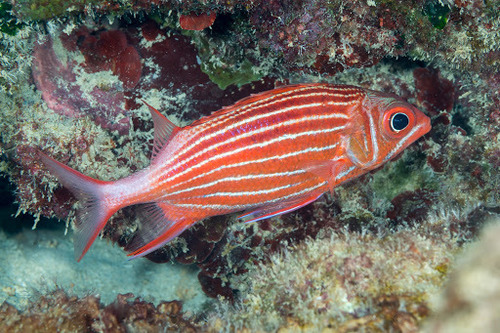
Crown Squirrelfish
Sargocentron diadema
The Crown Squirrelfish is the 'night watchman' of the Indo-Pacific reefs, sporting a regal red coat and a distinctive white-banded dorsal fin. This shy nocturnal beauty transforms from a reef-dweller into an active hunter the moment the sun dips below the horizon.
Quick Identification
Size
Up to 17 cm (6.7 inches) in length; typically weighs 100–150g (3.5–5.3 oz)
Colors
Brilliant red-to-orange body with 9-11 thin silvery-white horizontal stripes; the first dorsal fin is distinctive for its dark blackish-red color with a prominent white horizontal band.
Key Features
- Deep red body with narrow white longitudinal stripes
- Prominent black spinous dorsal fin with a white horizontal streak
- Large, dark nocturnal eyes
- Strong spine on the corner of the gill cover (preopercle)
When You’ll See Them
Geographic range
Where Does the Crown Squirrelfish Live?
The Crown Squirrelfish is widely distributed across the tropical waters of the Indo-Pacific region. This vast range begins in the Red Sea and along the East African coast, stretching across the Indian Ocean to the coral-rich waters of Southeast Asia, and extending deep into the Pacific to the Hawaiian Islands and the Tuamotu Archipelago. While they are a staple of the Great Barrier Reef in Australia and the Japanese archipelago, they are restricted to these warm, tropical environments and are not found in the Atlantic Ocean.
Basemap © OpenStreetMap contributors
Behavior
The Crown Squirrelfish is a secretive, nocturnal species that spends the majority of daylight hours seeking refuge. They are commonly found hovering almost motionlessly within the dark recesses of coral reefs, caves, or underneath ledge overhangs. While they are social enough to share these shelters with other squirrelfish or soldierfish, they remain wary of larger predators and divers, quickly retreating into the reef at the first sign of trouble.
When night falls, this species undergoes a behavioral shift, leaving the safety of the coral to forage over sandy patches and reef flats. They are solitary hunters under the cover of darkness, utilizing their large, light-sensitive eyes to locate small prey. Despite their relatively small size, they are hardy and territorial regarding their preferred daytime 'resting holes,' often returning to the same crevice morning after morning.
EverydayEarth exclusive
Camera Tips
To capture high-quality footage of a Crown Squirrelfish, you must position your underwater AI camera near 'transition zones'—the areas where the reef structure meets open sand. Because these fish are nocturnal, setting your camera to trigger on movement specifically during the hours after sunset is vital. Aim the lens toward the mouth of a known crevice or coral overhang; these fish are creatures of habit and will often emerge from the same spot every evening.
Lighting is the most critical factor for success. Standard white LEDs can startle squirrelfish, causing them to flee or exhibit unnatural behavior. Instead, use infrared (IR) sensors or a camera equipped with a red-light filter, which is less visible to many reef fish. This allows you to observe their natural foraging behavior without the 'deer in the headlights' effect. Ensure your camera is mounted securely to a weighted base or a reef-safe grip to prevent current-induced motion blur.
If you are using a backyard saltwater pond or a specialized reef-observation tank, you can encourage the Crown Squirrelfish to stay in the camera's frame by placing small amounts of frozen mysis shrimp or chopped clams in a mesh feeder nearby. Since they are attracted to the scent of crustaceans, this will draw them out of hiding. For the best results, set your camera to a high frame rate (at least 60fps) to capture their quick, darting movements as they hunt.
Similar Species
Species that look similar or are commonly confused with Crown Squirrelfish.
Frequently Asked Questions
Record Crown Squirrelfish at your habitat
Connect a camera to start building your own species record — AI identifies every visitor automatically.