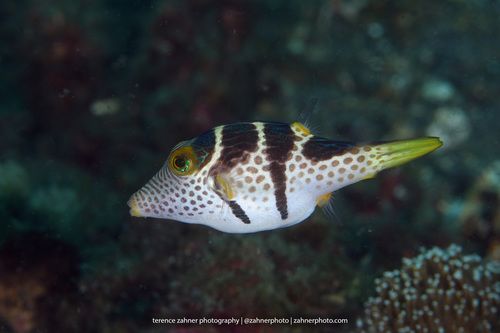
Blacksaddle Toby
Canthigaster valentini
A pint-sized puffer with a bold personality and toxic defense. Recognizable by its four black 'saddles,' this vibrant reef resident is a master of the Indo-Pacific coral gardens.
Quick Identification
Size
Small and compact, reaching a maximum length of 11 cm (4.3 inches).
Colors
Cream to white body with numerous brown-black spots; four distinct blackish 'saddles' or bands across the back; yellow-tinted fins and a yellow tail.
Key Features
- Four dark wedge-shaped saddles on the back
- Small, protruding 'sharp' snout
- Yellowish tail and pectoral fins
- Small brown spots covering the lower half of the body
When You’ll See Them
Geographic range
Where Does the Blacksaddle Toby Live?
The Blacksaddle Toby is a quintessential Indo-Pacific species, boasting a massive native range that stretches from the warm waters of the Red Sea and the East African coast all the way to the Tuamotu Islands in the South Pacific. They are common sights for divers and snorkelers throughout Southeast Asia, northern Australia—particularly the Great Barrier Reef—and as far north as southern Japan. This species is a resident of tropical and subtropical marine environments, rarely venturing into temperate waters.
Basemap © OpenStreetMap contributors
Behavior
The Blacksaddle Toby is a highly territorial and active reef inhabitant. They are typically found in small social groups, often consisting of one dominant male patrolling a territory that overlaps with several smaller territories of females. They are strictly diurnal, spending their daylight hours foraging and defending their patch of the reef before retreating into deep crevices or coral branches at night to sleep.
As members of the pufferfish family, they possess a unique defense mechanism: the ability to inflate their bodies by swallowing water or air, making them difficult for predators to swallow. More importantly, they are chemically defended. Their skin and internal organs contain tetrodotoxin, a potent neurotoxin that is lethal to most predators. Because they are so toxic, they move with a confident, slow swimming style, relying on their warning coloration to signal 'stay away' to potential threats.
EverydayEarth exclusive
Camera Tips
Capturing the Blacksaddle Toby requires a waterproof camera setup, ideally an action camera or a specialized reef-monitoring housing. Because these fish are small and relatively bold, you should place your camera on a weighted tripod or a stable rock formation at a depth of 2 to 10 meters, where light penetration is still high. Position the lens near a 'cleaning station' or a patch of algae-covered rock, as they return to these feeding spots frequently throughout the day.
To get the best clarity, avoid using digital zoom; instead, set the camera to a wide-angle or macro mode if available. These puffers are curious and may actually approach the camera lens to inspect their reflection. Using a 'red filter' on your lens can help restore the vibrant yellow and white tones that are often lost underwater due to light absorption. If you are using a backyard 'ocean pond' or saltwater aquarium setup, ensure the camera is placed at mid-water height to capture their distinctive hovering swimming style.
Time your recording for mid-day when the sun is directly overhead. This provides the best natural illumination for their complex patterns and prevents the black saddles from looking like silhouettes. Since they are territorial, look for a specific coral head they seem to favor; once you find their 'home base,' you can almost guarantee they will pass by the frame every few minutes. Avoid using high-intensity artificial lights if possible, as the sudden glare can startle them and cause them to retreat.
Frequently Asked Questions
Record Blacksaddle Toby at your habitat
Connect a camera to start building your own species record — AI identifies every visitor automatically.