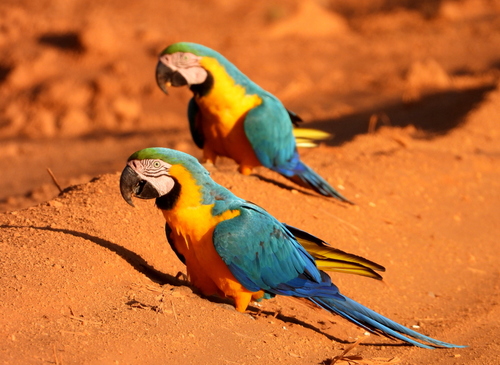
Blue-and-yellow Macaw
Ara ararauna
With its radiant turquoise wings and sun-drenched golden belly, the Blue-and-yellow Macaw is a living masterpiece of the tropical canopy. These intelligent, social giants are the crown jewels of the Amazon, known for their lifelong partnerships and thunderous calls.
Quick Identification
Size
Length of 32–36 inches (81–91 cm); wingspan of 40–45 inches (102–114 cm); weighs 2–2.5 lbs (0.9–1.1 kg)
Colors
Brilliant turquoise-blue upperparts with golden-yellow underparts; green crown; bare white facial skin with thin black feather lines
Key Features
- Striking blue back and bright yellow-orange belly
- White facial patch with fine black lines
- Long, tapering blue tail
- Massive black hooked beak
When You’ll See Them
Geographic range
Where Does the Blue-and-yellow Macaw Live?
This spectacular parrot is native to the heart of South America and southern Central America, spanning from eastern Panama across the vast Amazon Basin. Its core territory includes large swaths of Brazil, Venezuela, Colombia, Peru, and Bolivia, where it thrives in humid lowland forests. While extinct in some former island ranges like Trinidad, small introduced populations have successfully established themselves in urban parks and suburbs in Florida and Puerto Rico.
Basemap © OpenStreetMap contributors
Behavior
These macaws are incredibly social and intelligent birds, often seen flying in pairs or small family groups. They are famous for their loud, raucous calls that can carry for miles across the canopy, which they use to maintain contact with their flock. They are highly monogamous, usually mating for life and frequently seen preening one another to strengthen their bond.
In the wild, they are active foragers with a playful side, often hanging upside down to reach fruit or engaging in social play. While they are naturally wary of ground predators, they have a curious nature and, in areas where they are accustomed to humans, may visit gardens or feeders. Their ability to mimic sounds and 'talk' makes them famous, though in the wild, their vocalizations are purely functional for flock communication.
EverydayEarth exclusive
Camera Tips
To capture these high-flying beauties, position your camera at a significant height or directed toward a known food source. Since Blue-and-yellow Macaws are canopy dwellers, a ground-level camera will rarely see them unless they are visiting a bird bath or a low-hanging fruit tree. Aim your lens at a 45-degree upward angle toward palm trees or fruiting trees like figs and almonds, where they tend to congregate in the mornings.
If you live in a region where they visit backyards, platform feeders or high-mounted mineral blocks can serve as a lure. They are attracted to the color of bright fruits, but consistency is key; they follow established flight paths and food calendars. Use a fast shutter speed or a high-frame-rate video setting (at least 60fps) to capture the incredible detail of their feathers and the powerful motion of their wings, as they are surprisingly fast in flight.
Lighting is crucial for bringing out their vibrant colors. Position your camera with the sun at its back to avoid silhouettes, especially during their peak activity hours at dawn and dusk. Because they are social and often travel in pairs, ensure your camera has a wide-angle lens or is placed far enough back to capture the interaction between birds, rather than just a single close-up of a beak.
Similar Species
Species that look similar or are commonly confused with Blue-and-yellow Macaw.
Frequently Asked Questions
Record Blue-and-yellow Macaw at your habitat
Connect a camera to start building your own species record — AI identifies every visitor automatically.