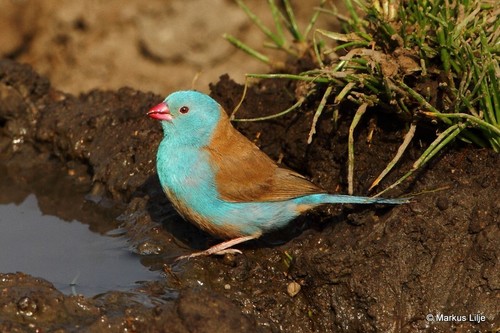
Blue-capped Cordonbleu
Uraeginthus cyanocephalus
A jewel of the East African savanna, the Blue-capped Cordonbleu captivates with its brilliant sky-blue plumage and charming, rhythmic courtship dances.
Quick Identification
Size
Length: 11.5–12 cm (4.5–4.7 in); Wingspan: 15–18 cm (6-7 in); Weight: 8–11 g (0.28–0.39 oz)
Colors
Males have a brilliant sky-blue head, throat, breast, and tail with cinnamon-brown wings and back. Females are paler with blue limited mostly to the face and tail.
Key Features
- Full sky-blue crown and face (males)
- Vibrant blue tail and rump
- Small, conical silver-grey bill
- Soft brownish-tan wings and mantle
When You’ll See Them
Geographic range
Where Does the Blue-capped Cordonbleu Live?
The Blue-capped Cordonbleu is a stunning resident of East Africa's diverse ecosystems. These birds are primarily found across Kenya and Tanzania, with their range extending northwards into southern Ethiopia, Somalia, and parts of South Sudan. While they are native to the African continent, they have become a beloved fixture in suburban gardens within their range due to their adaptability to human-altered landscapes and availability of supplemental water sources.
Basemap © OpenStreetMap contributors
Behavior
The Blue-capped Cordonbleu is an exceptionally social and energetic finch, often seen in small family groups or mixed-species flocks with other waxbills. They spend a significant portion of their day foraging on the ground, hopping with quick, light movements as they search for fallen seeds. One of their most fascinating behaviors is their complex courtship ritual; unlike many other songbirds, both the male and female perform a 'tap dance' while holding nesting material in their beaks, bobbing their heads in a rhythmic display of pair-bonding.
In suburban environments, these birds are known for their relatively bold nature once they become accustomed to human presence. They are frequent visitors to garden birdbaths, as they have a high requirement for regular water intake. While they can be shy when first approaching a new feeder, they quickly become 'regulars,' often arriving in pairs that stay close together throughout the day.
EverydayEarth exclusive
Camera Tips
To capture the stunning blue plumage of this finch, place your camera near a shallow water feature or birdbath. These birds are frequent drinkers and bathers, especially in the heat of the afternoon. Setting your camera at a low angle, roughly 6-12 inches off the ground, will provide the best perspective as they spend most of their time hopping on the soil or low stones. Use a macro lens setting if available, as these birds are quite small and require close proximity for high-quality detail.
For baiting, use a high-quality finch mix containing small millets or nyjer seeds. Scatter some seed directly on the ground in front of the camera to encourage natural foraging shots. Because they are fast-moving, a camera with a high shutter speed or a 'burst' photo mode is essential to catch them mid-hop or during their characteristic tail-flicking movements. Position the camera so the morning sun is behind you; the blue feathers are structural and look most vibrant when front-lit by the sun.
During the breeding season, you may be lucky enough to record their unique courtship dance. To increase the chances of this, provide fine nesting materials like dried grasses or feathers near the feeding area. Ensure your camera is set to a sensitive motion trigger, as their small body mass may not always trigger lower-end sensors. A 0.2 to 0.5-second trigger speed is ideal to ensure you don't just catch a trailing blue tail feather as they fly off.
Frequently Asked Questions
Record Blue-capped Cordonbleu at your habitat
Connect a camera to start building your own species record — AI identifies every visitor automatically.