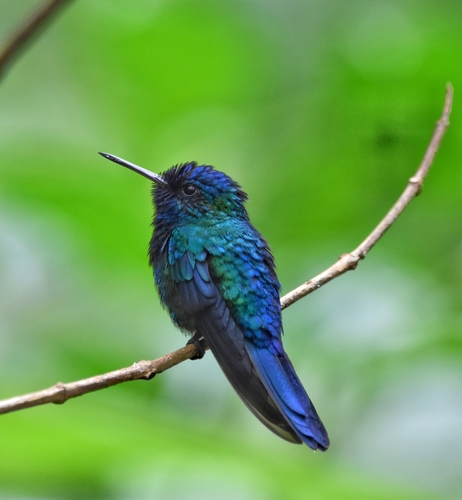
Blue-headed Hummingbird
Riccordia bicolor
A shimmering emerald gem of the Caribbean, the Blue-headed Hummingbird is a rare beauty found only on two islands. With its brilliant indigo crown and fearless spirit, it is the crown jewel of Lesser Antillean birdlife.
Quick Identification
Size
9-11 cm (3.5-4.3 in) in length; Wingspan approximately 12-14 cm (4.7-5.5 in); Weight: 4.5g (0.16 oz)
Colors
Males: Shimmering emerald green body with a deep, iridescent blue head and throat. Females: Bronze-green upperparts with a contrasting bright white breast and belly.
Key Features
- Brilliant iridescent blue head and throat in males
- Bright white underparts in females
- Dark blue-black tail with a slight notch
- Slightly curved black bill with a reddish base
When You’ll See Them
Geographic range
Where Does the Blue-headed Hummingbird Live?
The Blue-headed Hummingbird is a true island specialist, found natively and exclusively within the Caribbean region. Its core range is restricted to the lush, volcanic islands of Dominica and Martinique in the Lesser Antilles. Within these islands, it favors the high-humidity environments of interior mountain ranges and river valleys, making it a prized sighting for birdwatchers in the Eastern Caribbean.
Basemap © OpenStreetMap contributors
Behavior
While they are primarily creatures of the humid forest, they are remarkably adapted to the volcanic terrain of their home islands. Unlike many migratory hummingbirds, this species stays put year-round, moving only locally between elevations to follow the blooming cycles of tropical flora. They are generally solitary except when mating or when several gather at a particularly rich food source, like a flowering immortelle tree.
EverydayEarth exclusive
Camera Tips
Because these hummingbirds are frequent bathers, setting up a camera near a shallow, moving water feature or a misting station can provide unique behavioral footage. Unlike many species that prefer still water, hummingbirds are attracted to the sound of splashing or dripping. Mount your device at chest height (4-5 feet) and aim for a clean, non-distracting background to make the bird's emerald and blue colors pop. If you are in a forested area, look for tree ferns; they are the preferred nesting sites, and a well-placed trail cam (at a respectful distance) can document the nesting cycle between February and May.
Lighting is your biggest challenge in the humid forests they call home. If your setup allows, use a small external flash or choose a spot where the canopy opens up to allow natural light. Avoid placing cameras in deep, dark shadows, as the Blue-headed Hummingbird's dark tail and deep blue head can easily lose detail in low light. For the best results, use a high frame rate (at least 60fps) to slow down their rapid wing beats and see the incredible mechanics of their flight in playback.
Similar Species
Species that look similar or are commonly confused with Blue-headed Hummingbird.
Antillean Crested Hummingbird
Smaller with a prominent pointed crest; males have a blue-green crest rather than a fully blue head.
Purple-throated Carib
Much larger with a heavy, curved bill and a brilliant purple throat instead of a blue head.
Green-throated Carib
Lacks the blue head entirely, featuring a bright green throat and a slightly more curved bill.
Frequently Asked Questions
Record Blue-headed Hummingbird at your habitat
Connect a camera to start building your own species record — AI identifies every visitor automatically.