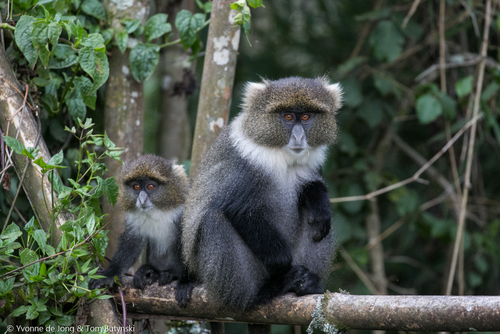
Blue Monkey
Cercopithecus mitis
With its regal white brow and slate-colored coat, the Blue Monkey is a master of the African canopy. Discover how to observe these intelligent, social primates as they navigate the forest edges and suburban gardens.
Quick Identification
Size
Body length 50-70 cm (20-28 in); tail length up to 100 cm (39 in); weight 4-8 kg (9-18 lbs)
Colors
Slate-grey to olive fur; black limbs and tail; characteristic white or yellowish 'diadem' band across the brow; greyish-white throat patch.
Key Features
- Distinctive pale 'diadem' band across the forehead
- Long, dark tail often significantly longer than the body
- Deep grey or olive coat that appears bluish in forest light
- Social groups often led by a single dominant male
When You’ll See Them
Geographic range
Where Does the Blue Monkey Live?
This species is native to the African continent, boasting a wide distribution across the forest belts of Central and East Africa. Their core range extends from the upper Congo River basin eastward to the East African Rift, spanning countries like Kenya, Uganda, and Tanzania. They also reach as far south as northern Angola, Zambia, and down the eastern coast into the forest patches of South Africa.
Basemap © OpenStreetMap contributors
Behavior
Blue monkeys are highly social primates that live in female-bonded groups, typically consisting of 10 to 40 individuals. These groups are matrilineal, meaning females stay in their birth groups for life while males disperse upon reaching maturity. A single adult male usually resides with the troop, acting as the primary defender against rival males and predators. They are highly vocal creatures, using a complex system of bird-like chirps, whistles, and loud 'pyow' alarm calls to communicate through the dense canopy.
While they are primarily arboreal and spend the majority of their time in the middle to upper layers of the forest, they are remarkably adaptable. In suburban areas bordering forests, they have learned to navigate human landscapes, often using rooftops and fences as travel corridors. They are intelligent foragers, displaying a high degree of curiosity and the ability to remember the locations of seasonally fruiting trees across their large home ranges.
EverydayEarth exclusive
Camera Tips
To successfully capture Blue Monkeys on an AI camera, you must think vertically. Because they are primarily arboreal, a standard ground-level camera trap will likely only catch a glimpse of a tail or a fleeting shadow. Instead, secure your camera 3 to 5 metres (10-15 feet) up a tree trunk that overlooks a 'natural bridge'—a place where branches from neighboring trees overlap, forming a clear path for the troop. Angle the camera slightly downward to capture their movement as they navigate the mid-canopy.
If you are monitoring a suburban garden, focus on 'corridor' trees that lead to fruit-bearing species like guava, loquat, or wild figs. Blue Monkeys are creatures of habit and will follow the same route daily. Setting your camera near these food sources is highly effective, but ensure the lens is shielded from the harsh morning or afternoon sun, as the glare can wash out the subtle slate-grey tones that give the species its name.
Because these monkeys move with surprising speed and agility, high-performance camera settings are a must. Set your trigger speed to the fastest possible setting and utilize a multi-shot or burst mode (3-5 photos per trigger). This increases your chances of getting a clear shot of the face or the distinctive white 'diadem' marking rather than just a blur of fur. Since they are strictly diurnal, you can conserve battery and SD card space by setting your camera to only record during daylight hours.
In drier climates or during the dry season, a high-platform water source can be an incredible lure. Blue Monkeys are wary of descending to the ground to drink due to predators like leopards or domestic dogs. Providing a secure birdbath or shallow basin on an elevated deck or a sturdy branch will frequently attract the entire troop, providing excellent opportunities for close-up, high-quality images of their social interactions and grooming behavior.
Similar Species
Species that look similar or are commonly confused with Blue Monkey.
Frequently Asked Questions
Record Blue Monkey at your habitat
Connect a camera to start building your own species record — AI identifies every visitor automatically.