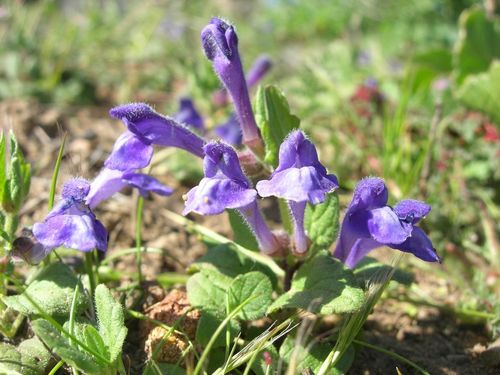
blue skullcap
Scutellaria tuberosa
A hidden gem of the West Coast, the blue skullcap is a low-growing wildflower famous for its vibrant violet blooms and unique hood-shaped petals. Often appearing in the wake of forest fires, this hardy perennial is a master of survival in woodland and chaparral habitats.
Quick Identification
Size
5 to 25 cm (2 to 10 inches) in height; flowers are 12 to 18 mm long
Colors
Violet-blue to deep purple flowers with white markings on the lower lip; grayish-green hairy foliage
Key Features
- Square-shaped stems typical of the mint family
- Hood-like or helmet-shaped violet flowers
- Small potato-like tubers found on the root system
- Opposite, oval-shaped leaves with scalloped edges
When You’ll See Them
Geographic range
Where Does the blue skullcap Live?
Native to the western coast of North America, the blue skullcap is primarily found in the United States and Mexico. Its core range extends from south-central Oregon through the length of California, reaching down into the northern regions of Baja California. It thrives in both the coastal ranges and the foothills of the Sierra Nevada mountains, often appearing in scattered populations where the soil and sunlight conditions are just right.
Basemap © OpenStreetMap contributors
Behavior
Blue skullcap, often known as Danny's skullcap, is a resilient perennial that spends a significant portion of its life cycle underground. Emerging in early spring, it utilizes small, fleshy tubers to store energy, allowing it to sprout quickly when soil moisture is high. Unlike many larger shrubs, this species stays close to the ground, forming small, charming patches that provide a burst of color to the forest floor.
As a member of the mint family, it has a distinct growth pattern with rigid, square stems and opposite leaves. While it does not spread aggressively like garden mints, it is a pioneer species in fire-affected areas. It is one of the first plants to take advantage of the nutrient-rich ash and increased sunlight after a wildfire, playing a vital role in early-succession ecosystems and stabilizing soil before larger plants return.
EverydayEarth exclusive
Camera Tips
Capturing the blue skullcap on a backyard or trail camera requires a different approach than filming mobile wildlife. Because this plant rarely exceeds 10 inches in height, you should mount your camera very low to the ground—ideally just 5 to 6 inches high. Using a small tripod or a ground-level stake is much more effective than a tree strap. Tilt the camera slightly upward to capture the unique 'skullcap' shape of the flowers against the sky or forest canopy.
For the best results, use a camera with a 'Macro' or close-focus mode, as many standard trail cameras have a minimum focus distance of 3 to 5 feet, which will leave these small flowers looking blurry. If your camera allows for time-lapse settings, set it to take a photo every 15 to 30 minutes during the morning hours. This can create a stunning sequence showing the flowers opening and following the sun, or even the rapid growth of the stem during the peak of spring.
Since blue skullcap is a favorite for native bees and butterflies, setting your camera to its most sensitive motion trigger can help you capture 'action' shots of pollinators. Avoid using a flash at night, as it will wash out the delicate violet hues; instead, rely on the natural, filtered light of early morning or late afternoon for the most color-accurate photos. If you are placing the camera in a sunny spot, use a small shade or position the camera facing north to prevent harsh glares from ruining the petal details.
Frequently Asked Questions
Record blue skullcap at your habitat
Connect a camera to start building your own species record — AI identifies every visitor automatically.