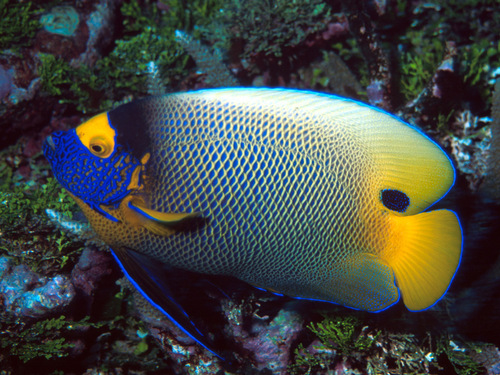
Blueface Angelfish
Pomacanthus xanthometopon
Draped in electric blues and a signature yellow mask, the Blueface Angelfish is a crown jewel of the Indo-Pacific reefs. This shy beauty brings a splash of neon brilliance to the coral crevices it calls home.
Quick Identification
Size
Grows up to 38 cm (15 inches) in length
Colors
Bright electric blue face with yellow reticulation; prominent yellow 'mask' over the eyes; yellow pectoral and dorsal fins; scales on the body have blue margins
Key Features
- Vivid yellow 'mask' covering the eyes and face
- Electric blue reticulated pattern on the head
- Small yellow spot at the rear base of the dorsal fin
- Juveniles feature vertical bands of black, white, and electric blue
When You’ll See Them
Geographic range
Where Does the Blueface Angelfish Live?
The Blueface Angelfish is widely distributed across the tropical waters of the Indo-Pacific region. Its native range begins in the Indian Ocean near the Maldives and extends eastward through the Indonesian archipelago, the Philippines, and the northern coast of Australia, including the Great Barrier Reef. To the north, they are found as far as the Ryukyu Islands of Japan, and to the east, they populate various island chains throughout Micronesia and Melanesia. They are strictly marine and do not have any known introduced freshwater populations.
Basemap © OpenStreetMap contributors
Behavior
The Blueface Angelfish is a primarily solitary species known for its shy and somewhat reclusive nature. In the wild, they are most often found patrolling reef slopes and lagoons, where they stick close to caves, ledges, and coral overhangs. They are highly territorial toward other angelfish and will often use these rocky retreats to hide at the first sign of danger or a diver's approach.
Interestingly, these fish are capable of producing audible 'grunting' or clicking sounds, especially when they feel threatened or are defending their territory from intruders. While they appear serene as they glide through the water, they are opportunistic foragers that spend the majority of their daylight hours nipping at the reef substrate. In captive reef environments, they are known for their intelligence and can eventually learn to recognize the person who feeds them.
EverydayEarth exclusive
Camera Tips
To capture the stunning colors of a Blueface Angelfish on an underwater trail camera or drop-cam, placement is everything. These fish are 'structure-oriented,' meaning they rarely venture far into open water. Position your camera near a large coral 'bommie' or an overhang where sponges are visible. Angle the camera slightly upward to leverage natural light; the sunlight filtering through the water is essential to make the iridescent blue of their face truly shine. If your camera has a white balance setting, 'Underwater Mode' is a must to prevent the image from looking too green or blue.
Because the Blueface Angelfish is naturally skittish, a stationary 'set-and-forget' approach works better than a handheld ROV. Leave your camera in place for at least 45 minutes to allow the fish to become accustomed to the new object in their territory. You can encourage a closer approach by using a mesh bait bag filled with a mixture of chopped shrimp and algae-based pellets secured near the camera's field of view. Ensure the bait bag is tied down so it doesn't drift and block the lens.
For those using cameras in a large home reef aquarium, the challenge is often the fast, darting movements of the fish. Use a high frame rate (60fps or higher) to capture crisp video that won't blur when the fish turns quickly. External mounting is preferred to avoid salt creep on the lens. Try to time your recording for the 'golden hour' of your tank's lighting cycle when the blue actinic lights are on, as this will highlight the neon margins of their scales and their namesake blue face.
Similar Species
Species that look similar or are commonly confused with Blueface Angelfish.
Frequently Asked Questions
Record Blueface Angelfish at your habitat
Connect a camera to start building your own species record — AI identifies every visitor automatically.