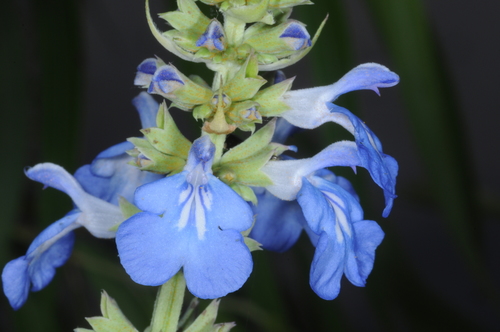
Bog sage
Salvia uliginosa
A towering, azure-flowered beauty that thrives where other plants falter, Bog sage is a wetland wonder. Its sky-blue blooms and swaying stems make it the ultimate centerpiece for any pollinator-focused backyard.
Quick Identification
Size
Height of 3 to 6 feet (0.9 to 1.8 meters) with a spread of 2 to 3 feet (0.6 to 0.9 meters)
Colors
Brilliant sky-blue (azure) petals with white markings on the lower lip; bright green lance-shaped foliage
Key Features
- Tall, wiry stems that sway easily in the wind
- Distinctive sky-blue flowers with white bee-line throats
- Serrated, lanceolate leaves with a minty scent when crushed
- Spreading growth habit via underground rhizomes
When You’ll See Them
Geographic range
Where Does the Bog sage Live?
Bog sage is native to the temperate and subtropical regions of South America, specifically originating in the marshy wetlands of southern Brazil, Uruguay, and Argentina. Because of its incredible ornamental value and vibrant blue hue, it has been widely introduced to garden landscapes across North America, Europe, and parts of Australia. In these regions, it frequently naturalizes in damp ditches, riparian zones, and suburban areas with high water tables.
Basemap © OpenStreetMap contributors
Behavior
Bog sage is a vigorous perennial that is most famous for its 'dancing' behavior. Unlike many woody shrubs, its stems are remarkably thin and flexible, allowing the plant to sway gracefully in the slightest breeze. This movement is not just aesthetic; it helps the plant shed excess moisture in its naturally damp habitats and attracts the attention of passing pollinators. It is a colonial grower, meaning it uses underground runners to slowly expand into lush clumps over several seasons.
In a backyard ecosystem, Bog sage acts as a social hub for local wildlife. While the plant itself is stationary, it is rarely seen without visitors. It is a high-reward nectar source, specifically adapted to support long-tongued insects and birds. Unlike many other Salvia species that bloom in spring, Bog sage waits until the heat of late summer to reach its peak, providing a critical food source when other floral options might be fading.
EverydayEarth exclusive
Camera Tips
To capture the best footage of visitors to your Bog sage, position your camera at a height of approximately 3 to 4 feet. Since the flowers grow on the ends of tall, wiry stems, this height ensures you are level with the 'action zone' where hummingbirds and butterflies hover. Angle the camera slightly downward to catch the intricate white 'bee-line' patterns on the lower petals, which are designed to guide insects into the nectar well.
Because Bog sage stems are so flexible, they move significantly in the wind. This can lead to hundreds of 'false' triggers on some AI cameras. To manage this, use a camera with adjustable detection zones and focus the trigger area specifically on the flower spikes rather than the leaves. Alternatively, if your camera supports it, decrease the motion sensitivity slightly during windy days, or stake the main stems of the plant to a bamboo rod just outside the camera's field of view to keep them steady.
The sky-blue color of Salvia uliginosa is notoriously difficult for some digital sensors to render accurately, often appearing more purple or washed out in direct midday sun. For the most vibrant images, set your camera to record during the 'golden hours' of early morning or late afternoon. The softer light will make the azure blue pop and will also coincide with the peak feeding times for the hummingbirds and sphinx moths that frequent the plant.
Frequently Asked Questions
Record Bog sage at your habitat
Connect a camera to start building your own species record — AI identifies every visitor automatically.