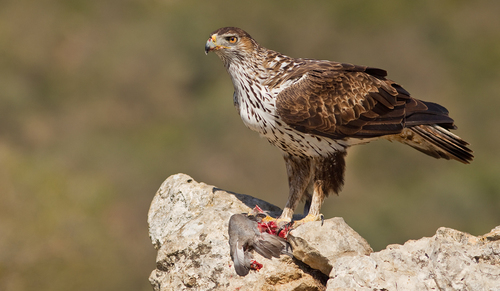
Bonelli's Eagle
Aquila fasciata
Master of the rocky crags and the high-speed ambush, Bonelli's Eagle is a stunning raptor of the Old World. With its piercing gaze and streaked white plumage, it represents the wild spirit of the Mediterranean hills.
Quick Identification
Size
Length: 55-74 cm (22-29 in); Wingspan: 143-163 cm (56-64 in); Weight: 1.4-2.5 kg (3.1-5.5 lbs)
Colors
Adults feature dark chocolate-brown upperparts and creamy white underparts with fine dark vertical streaks. They are famous for a distinct white 'V' or patch on the mantle (upper back).
Key Features
- Pale underparts with dark vertical streaking
- Prominent white patch on the upper back (adults)
- Long, squared tail with a wide black terminal band
- Feathered legs reaching down to the yellow talons
When You’ll See Them
Geographic range
Where Does the Bonelli's Eagle Live?
Native to a vast stretch of the Palearctic and Indomalayan regions, Bonelli's Eagle is most commonly found across the Mediterranean basin, including Spain, Portugal, Greece, and North Africa. Its range extends eastward through the Middle East into the Indian subcontinent and reaches as far as southeastern China and Indonesia. While they are primarily resident breeders that stay in their territory year-round, young birds may wander significantly from their birth sites before establishing their own home range.
Basemap © OpenStreetMap contributors
Behavior
Bonelli's Eagle is a formidable and agile predator, often referred to as the 'sprinter' of the eagle world due to its incredible speed during low-altitude hunts. Unlike many larger eagles that rely on soaring at great heights, this species often hunts from cover or through high-speed contour flying, weaving through trees and rocky outcrops to ambush its prey. It is highly territorial and typically lives in pairs that remain together throughout the year, often using the same nesting site for decades.
While generally shy and inclined to avoid human-heavy environments, they are a hallmark species of Mediterranean-style landscapes and traditional agricultural zones. They are mostly silent birds, though they engage in spectacular aerial displays during the breeding season. These 'sky dances' involve breathtaking dives and upward swoops, serving as a clear signal to other eagles to keep their distance from the pair's established territory.
EverydayEarth exclusive
Camera Tips
To capture a Bonelli's Eagle on a trail camera, focus on high-vantage points. If your property has a rocky ridge or a tall, isolated tree overlooking an open field, these are prime spots. Place the camera 6-10 feet high on a sturdy branch or pole, angled slightly downward. These eagles often use specific 'lookout' perches to scan for movement below, and finding one of these favored spots is the key to getting a high-quality close-up.
Because these raptors are exceptionally wary of human presence and new objects, use a camera with a camouflaged housing and ensure it is positioned so it doesn't catch direct sunlight, which can cause lens flare and alert the bird to the glass surface. Cellular cameras are ideal here, as they allow you to monitor the feed without visiting the site and leaving human scent or disturbing the area frequently.
While they don't visit traditional bird feeders, a large, ground-level water feature like a stone basin or a small pond in a quiet area can be a major draw, especially in arid climates during the summer months. Set your camera to 'Burst Mode' or a very short trigger interval. A Bonelli's Eagle landing or taking off happens in a split second, and you’ll want a sequence of shots to ensure you capture the magnificent wing spread and the white patch on the back.
Similar Species
Species that look similar or are commonly confused with Bonelli's Eagle.
Golden Eagle
Much larger and darker overall; lacks the white underparts and the white patch on the upper back.
Booted Eagle
Smaller with a more varied color palette; the pale-phase Booted Eagle has whiter, unstreaked underparts compared to Bonelli's.
Short-toed Snake Eagle
Has a larger, more rounded 'owl-like' head, yellow eyes, and lacks the feathered legs (boots) of the Bonelli's.
Frequently Asked Questions
Record Bonelli's Eagle at your habitat
Connect a camera to start building your own species record — AI identifies every visitor automatically.