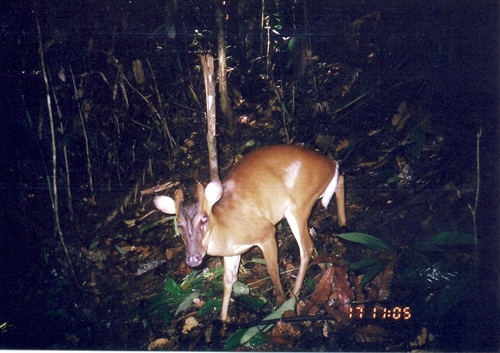
Bornean Yellow Muntjac
Muntiacus atherodes
The Bornean Yellow Muntjac is a golden-hued forest dweller found nowhere else on Earth. Known as the 'barking deer,' this shy, day-active herbivore is a master of the Bornean undergrowth.
Quick Identification
Size
Shoulder height 40-50 cm (16-20 in); Weight 13-18 kg (29-40 lbs)
Colors
Bright yellowish-orange to reddish-tawny coat; creamy white underparts; dark brownish stripe along the nape of the neck
Key Features
- Small unbranched antlers (1.5-4 cm long) in males
- Diurnal activity pattern unlike most deer
- Distinctive barking alarm call
- Slender build with a characteristic arched back
When You’ll See Them
Geographic range
Where Does the Bornean Yellow Muntjac Live?
This species is entirely endemic to the island of Borneo. It is found throughout the rainforests of the Malaysian states of Sabah and Sarawak, across the Indonesian provinces of Kalimantan, and within the Sultanate of Brunei. While it shares some territory with the more widespread Red Muntjac, it is much more restricted to the island's interior moist forest blocks.
Basemap © OpenStreetMap contributors
Behavior
The Bornean Yellow Muntjac is a solitary and secretive deer that spends its life navigating the dense understory of Borneo's rainforests. Unlike many other muntjac species that are most active at night or during twilight, the Yellow Muntjac is primarily diurnal, meaning it is most active during the daylight hours. They are highly territorial and use scent glands located on their forehead and feet to mark their home ranges.
When threatened, these deer emit a loud, resonant bark that sounds remarkably like a dog. This 'barking' serves as an alarm signal to other muntjacs and informs a predator that it has been detected, often discouraging a pursuit. Because of their small size, they are masters of the 'low-crawl,' ducking under thick vines and logs where larger predators like the Sunda Clouded Leopard might struggle to follow.
EverydayEarth exclusive
Camera Tips
Capturing the Bornean Yellow Muntjac requires understanding their diurnal nature. Position your camera to take advantage of peak daylight hours between 7 AM and 5 PM. Because these deer are small, mount your camera low to the ground—about 30 to 45 centimeters (12 to 18 inches) high. This 'eye-level' perspective captures the best detail of their facial markings and the small, unbranched antlers that distinguish them from other species.
Focus your camera on narrow, well-trodden game trails or near natural 'hotspots' like fallen wild fruit trees (especially wild figs). Unlike many temperate deer, the Yellow Muntjac is less attracted to salt licks and more focused on seasonal fruit drops. Ensure your camera has a fast trigger speed; these deer move with a cautious but steady pace, and a slow trigger might only capture a tail as they disappear into the brush.
Humidity is the biggest challenge in Bornean environments. Use high-quality lithium batteries and place several desiccant packs inside the camera housing to prevent lens fogging during the morning transition from cool to hot. If your camera supports it, high-definition video is preferred over stills; the subtle 'barking' vocalization and the way they scent-mark with their preorbital glands are fascinating behaviors that photos alone cannot fully capture.
Frequently Asked Questions
Record Bornean Yellow Muntjac at your habitat
Connect a camera to start building your own species record — AI identifies every visitor automatically.