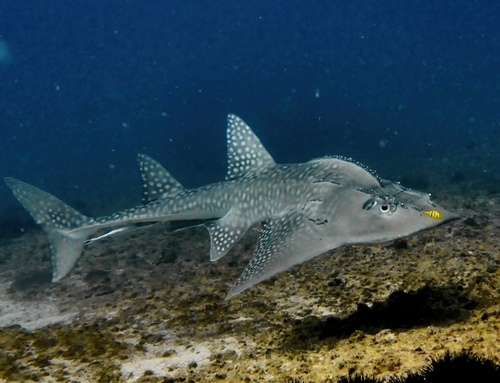
Bowmouth Guitarfish
Rhina ancylostomus
Looking like a prehistoric cross between a shark and a ray, the Bowmouth Guitarfish is one of the ocean's most distinctive and rare treasures. With its thorny crown and starry white spots, this 'Shark Ray' is a breathtaking sight for any underwater observer.
Quick Identification
Size
Reaches lengths of up to 2.7 metres (8.9 feet) and can weigh as much as 135 kilograms (298 pounds).
Colors
Dorsal surface is typically bluish-gray, brown, or charcoal with scattered white spots; prominent black markings are found above the pectoral fins.
Key Features
- Distinctive thorny ridges over the eyes and along the midline of the back
- Wide, rounded snout with a unique W-shaped undulating mouth line
- Large, triangular shark-like dorsal fins and a powerful heterocercal tail
- A blend of ray-like flattened head and shark-like muscular body
When You’ll See Them
Geographic range
Where Does the Bowmouth Guitarfish Live?
The Bowmouth Guitarfish is native to the warm, tropical waters of the Indo-Pacific. Its territory spans a massive area from the Red Sea and East Africa across the Indian Ocean to the tropical Western Pacific, including the waters of Indonesia and the Philippines. While they are most commonly associated with the northern coast of Australia, they are also found as far north as the southern reaches of Japan and Korea.
Basemap © OpenStreetMap contributors
Behavior
The Bowmouth Guitarfish, often called the 'Shark Ray,' is a primarily solitary, bottom-dwelling species that spends its time cruising over sandy or muddy substrates near coral reefs. Despite its intimidating appearance and the sharp, defensive thorns along its head, it is a relatively docile and shy creature that generally avoids contact with humans. They are strong swimmers, moving with more agility than many other ray species thanks to their shark-like tail.
These rays are most active when hunting, using their highly sensitive snouts to detect prey buried in the sand. Socially, they are not known to form large schools, though they may gather in areas with high food density or at cleaning stations where smaller fish remove parasites from their skin. They are ovoviviparous, giving birth to live young that have nourished themselves on yolk sacs within the mother.
EverydayEarth exclusive
Camera Tips
Capturing a Bowmouth Guitarfish on camera requires specialized underwater equipment, as they are strictly marine dwellers. If you are setting up a camera near a pier, dock, or shallow reef where these rays are known to frequent, a waterproof action camera with a wide-angle lens is essential. Mount the camera on a weighted tripod or a fixed underwater structure about one to two feet off the sandy bottom, angled slightly upward to catch the silhouette of the fish as it glides overhead.
These rays are attracted to areas with high crustacean activity. Placing your camera near a known crab colony or a 'cleaning station'—where small wrasse or cleaner shrimp congregate—will significantly increase your chances of a sighting. Because they are often found in areas with tidal movement, ensure your housing is securely anchored against currents and use a lens hood to minimize glare from the sun filtering through the water's surface.
Since the Bowmouth Guitarfish is active both day and night, use a camera with high-quality low-light sensors or a subtle infrared flash. White light flashes can startle marine life and cause 'backscatter' (reflecting off particles in the water), so infrared is preferred for night shots. If you are using a triggered system, set a fast shutter speed to capture the powerful movement of their shark-like tails without motion blur. Regularly cleaning the lens of salt buildup and algae is the most important maintenance task for long-term underwater deployments.
Frequently Asked Questions
Record Bowmouth Guitarfish at your habitat
Connect a camera to start building your own species record — AI identifies every visitor automatically.