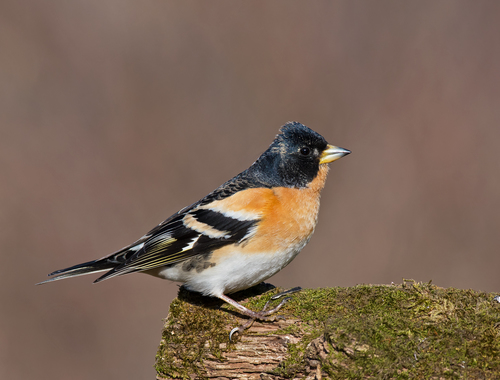
Brambling
Fringilla montifringilla
A hardy traveler from the Arctic taiga, the Brambling brings a flash of brilliant orange and white to winter gardens. These nomadic finches are famous for their massive, swirling flocks and their special love for beech forests.
Quick Identification
Size
Length: 14-16 cm (5.5-6.3 in); Wingspan: 25-28 cm (9.8-11 in); Weight: 17-30 g (0.6-1.1 oz)
Colors
Bright orange breast and shoulders, white belly, and a distinctive white rump. Males have jet-black heads in summer which fade to a mottled brown-gray in winter; females have duller, brown-patterned plumage.
Key Features
- Bright white rump clearly visible during flight
- Warm orange breast and wing bars
- Dark, mottled head that turns solid black in breeding males
- Similar size and notched tail to a Chaffinch
When You’ll See Them
Geographic range
Where Does the Brambling Live?
Native to the northern reaches of the Palearctic, the Brambling is a quintessential traveler of the boreal forests. Its breeding range spans the broad taiga belt from Norway and Sweden across Russia to the shores of the Pacific. As a migratory species, it moves south in massive waves to spend the winter in Western and Central Europe, the Mediterranean basin, and throughout East Asia, including China and Japan. While they are not native to the Americas, rare vagrants are occasionally spotted along the western coast of North America during extreme weather events.
Basemap © OpenStreetMap contributors
Behavior
Bramblings are highly social birds known for their impressive winter aggregations. Unlike many solitary garden birds, Bramblings travel in nomadic flocks that can number in the thousands, or even millions, when they find a rich food source. They are often nicknamed the 'Cock o' the North' due to their northern breeding origins. In the backyard, they are relatively shy compared to House Sparrows but will grow bolder if a reliable food source is established.
Their behavior is closely tied to the availability of beech mast (the seeds of beech trees). In years where beech seeds are abundant in the forest, you may not see them at all; however, when the crop fails, they descend on garden feeders in large numbers. They spend much of their time foraging on the ground, hopping with a characteristic upright posture while searching for fallen seeds.
EverydayEarth exclusive
Camera Tips
To capture the best footage of a Brambling, focus your camera on ground-level feeding areas or low platform feeders. These finches are naturally comfortable foraging on the forest floor, so they are more likely to linger in front of a camera positioned 6-12 inches off the ground rather than one high up in a tree. Use a wide-angle lens setting if available, as they often arrive in small groups rather than alone.
The most effective 'bait' for a Brambling is a mix of sunflower hearts and crushed peanuts spread directly on the ground or on a flat stone. If you have beech trees nearby, placing your camera near the leaf litter where beech mast has fallen is a guaranteed way to see them in their natural foraging element. Since they are winter visitors, ensure your camera has fresh batteries or a solar panel, as cold temperatures can drain power quickly.
Set your camera to take short video bursts (10-15 seconds) with a high frame rate. Bramblings are twitchy and fast-moving; high-speed capture will help you identify the mottled patterns on their heads and the flash of their white rumps as they take flight. Early morning light is best, as it highlights the vibrant orange of their breast feathers against the stark winter landscape.
Frequently Asked Questions
Record Brambling at your habitat
Connect a camera to start building your own species record — AI identifies every visitor automatically.