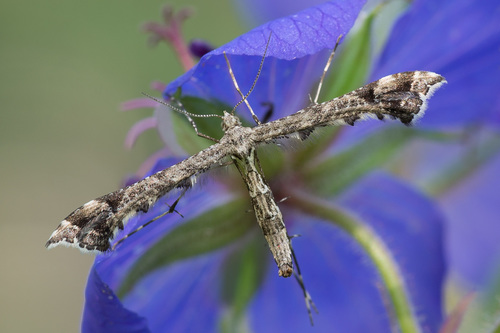
Brindled Plume-moth
Amblyptilia punctidactyla
A master of architectural camouflage, the Brindled Plume-moth is famous for its striking 'T' shaped silhouette and feathery, plume-like wings. This nocturnal wanderer is a fascinating find for any backyard explorer with a keen eye for detail.
Quick Identification
Size
Wingspan of 18–23 mm (0.7–0.9 inches); body length approximately 10–12 mm.
Colors
Mottled mix of charcoal grey, dark brown, and blackish-brown with white speckling; legs are distinctly ringed with dark and light bands.
Key Features
- Distinctive 'T' shaped resting posture with wings held perpendicular to the body
- Forewings marbled with dark grey and black scales
- Legs feature conspicuous white and dark brown rings
- Hindwings (usually hidden) are deeply cleft into feathery plumes
When You’ll See Them
Geographic range
Where Does the Brindled Plume-moth Live?
Native across the vast Palearctic region, the Brindled Plume-moth enjoys a wide distribution from the British Isles and Western Europe through to Japan. It is commonly found across Scandinavia, Central Europe, and the northern reaches of Asia, thriving in temperate climates where its host plants are abundant. While not found in the Americas, it is a staple of the insect fauna across most of the Eurasian landmass.
Basemap © OpenStreetMap contributors
Behavior
The Brindled Plume-moth is an expert in the art of concealment. When resting, it adopts a rigid, 'T' shaped posture that breaks up its insectoid silhouette, allowing it to blend seamlessly against lichen-covered bark, weathered fence posts, or dried plant stems. This mimicry is so effective that the moth often resembles a small, discarded twig or a piece of debris rather than a living creature.
While primarily nocturnal, this species is easily flushed from deep foliage during the day, performing a brief, erratic flight before quickly diving back into cover. They are attracted to artificial light sources, making them frequent visitors to porch lights and lighted windows. Interestingly, the final generation of the year hibernates as adults, tucking themselves into outbuildings or thick ivy to survive the winter months before emerging in early spring.
EverydayEarth exclusive
Camera Tips
To successfully capture the Brindled Plume-moth on an AI-powered camera, placement is everything. These moths are relatively small, so a macro lens or a camera with a close-focusing distance is vital. Position your camera near stands of Hedge Woundwort or garden Geraniums, as these host plants are the most likely spots for the moth to land for egg-laying or resting. Aim the lens at the flower spikes or the undersides of large leaves, where the moths often hide during the day and early evening.
Because they are drawn to light, you can significantly increase your chances by setting up your camera near a low-intensity UV light or a 'moth wall'—a white sheet illuminated by a light source. The moth's unique 'T' shape is its most diagnostic feature, so try to capture side-profile or top-down shots. If your camera has adjustable trigger sensitivity, set it to high; these moths are lightweight and their jerky flight might not always trigger standard PIR sensors without a close-range setup.
Seasonality plays a major role in your success. While they have multiple broods, the highest activity occurs in mid-to-late summer. However, don't overlook the colder months; because they hibernate as adults, you may spot them on your camera on unusually mild winter nights or in early spring when they first emerge from their hiding spots in ivy or garden sheds. Use a fast shutter speed if you are using a flash, as their flight is deceptively quick when they decide to move.
Frequently Asked Questions
Record Brindled Plume-moth at your habitat
Connect a camera to start building your own species record — AI identifies every visitor automatically.