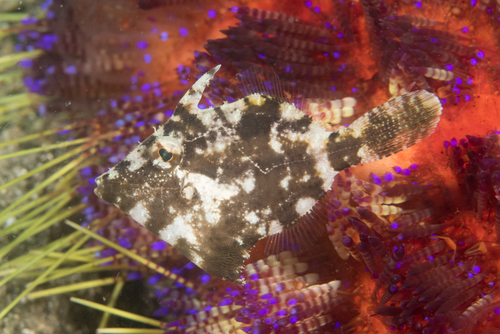
Bristle-tail Leatherjacket
Acreichthys tomentosus
A master of disguise in the tropical shallows, the Bristle-tail Leatherjacket uses shape-shifting skin and mottled colors to vanish into the seagrass.
Quick Identification
Size
Maximum length of 12 cm (4.7 inches)
Colors
Mottled olive green, brown, and tan; capable of rapid color and texture changes to match surroundings.
Key Features
- Large retractable first dorsal spine above the eye
- Rough, sandpaper-like skin with fleshy tassels (cirri)
- Deep, laterally compressed body with a small upturned mouth
When You’ll See Them
Geographic range
Where Does the Bristle-tail Leatherjacket Live?
The Bristle-tail Leatherjacket is native to the vast tropical waters of the Indo-West Pacific. Its range begins along the East African coast and stretches across to Fiji and the Solomon Islands, reaching as far north as the Ryukyu Islands of Japan and southward to the northern coastlines of Australia. While it is a common sight in the coral-rich waters of Indonesia and the Philippines, it is strictly a marine species and does not have introduced populations in freshwater or non-tropical regions.
Basemap © OpenStreetMap contributors
Behavior
The Bristle-tail Leatherjacket is a master of mimicry, often found drifting at odd angles among seagrass or coral to resemble a piece of floating debris. Unlike many reef fish that rely on speed to escape danger, this species uses its incredible ability to change both its color and skin texture—raising small fleshy filaments called cirri—to blend perfectly into its environment. This cryptic behavior makes it a fascinating subject for patient observers.
Generally solitary and slow-moving, they use their soft dorsal and anal fins for precise, helicopter-like maneuvering rather than fast swimming. In an aquarium or coastal environment, they are known for their inquisitive but shy nature, often 'peeking' from behind vegetation to observe their surroundings. While peaceful toward most neighbors, they are highly focused hunters when they spot their preferred prey.
EverydayEarth exclusive
Camera Tips
To capture the Bristle-tail Leatherjacket on camera, you will need an underwater housing or a specialized aquarium camera setup. Because these fish are masters of camouflage, standard autofocus can often struggle to distinguish them from the background seagrass or algae. For the best results, use a camera with a high-quality macro lens and set your focus to a narrow area. Side-lighting is essential; using a direct front-on flash or strobe often flattens the image and loses the incredible 'bristle' textures on their skin.
If you are filming in a coastal 'backyard' such as a dock or a shallow lagoon, position your camera at a depth of 1 to 2 meters near patches of macroalgae or seagrass. They are most active during the mid-morning when the sun provides high visibility through the water column. To draw them into the frame, look for areas where Aiptasia anemones are growing, as these are a primary food source and the fish will return to these 'hunting grounds' repeatedly.
Since they move slowly and spend much of their time hovering, use a high-frame-rate video setting to capture the subtle undulations of their translucent fins. Avoid high-flow areas; these fish prefer the calm, sheltered waters where they can remain stationary. If you are using a baited camera trap, a small mesh bag with crushed shrimp can be effective, but be prepared for them to approach cautiously, often taking several minutes to emerge from the weeds.
Frequently Asked Questions
Record Bristle-tail Leatherjacket at your habitat
Connect a camera to start building your own species record — AI identifies every visitor automatically.