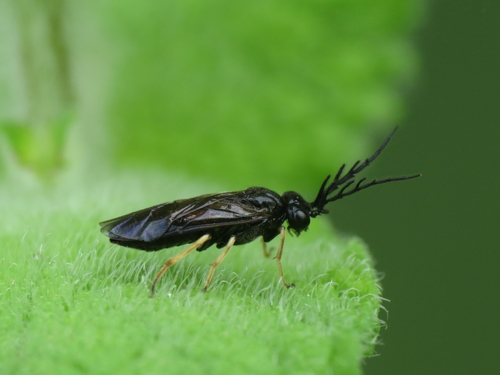
bristly rose sawfly
Cladius pectinicornis
A tiny marvel of the garden world, the bristly rose sawfly is famous for its comb-like antennae and its 'skeletonizing' larvae. This resilient insect is a common visitor to backyards wherever roses bloom.
Quick Identification
Size
Adults: 5–9 mm (0.2–0.35 in); Larvae: up to 15 mm (0.6 in) long
Colors
Adults are mostly black with pale white or yellowish legs. Larvae are translucent pale green with small white tufts of hair.
Key Features
- Males possess distinct comb-like (pectinate) antennae
- Larvae are covered in small, bristly white tubercles
- Adult females have a saw-like appendage for laying eggs
- Larvae create circular holes or skeletonized patterns on rose leaves
When You’ll See Them
Geographic range
Where Does the bristly rose sawfly Live?
The bristly rose sawfly is native to the Palearctic region, spanning across Europe and Northern Asia. It has successfully expanded its territory through the global nursery trade and is now widely established in North America, particularly across the United States and Southern Canada. This insect is a common inhabitant of any temperate region where its primary host plant, the rose, is grown for landscaping or occurs naturally in the wild.
Basemap © OpenStreetMap contributors
Behavior
The bristly rose sawfly is primarily known for the damage its larvae cause to ornamental plants. While the adults are inconspicuous and short-lived, the larvae are voracious eaters. They typically reside on the undersides of leaves to avoid predators and the drying effects of the sun. When disturbed, the larvae often exhibit a characteristic 'C-shaped' defensive posture, curling their bodies tightly.
Unlike many other garden insects, these sawflies are solitary as adults. They do not form hives or colonies. The life cycle is rapid, often allowing for multiple generations within a single summer season. This means that a small population in the spring can quickly expand by mid-summer if host plants are abundant and weather conditions remain temperate.
EverydayEarth exclusive
Camera Tips
To successfully capture the bristly rose sawfly, you must think small. These insects are best observed using macro lenses or high-resolution cameras with a very close focal point. Position your camera specifically on the underside of rose leaves where the larvae are most likely to feed. Because they move slowly, they are excellent subjects for time-lapse photography, which can reveal their 'skeletonizing' feeding behavior over several hours.
Lighting is the biggest hurdle when photographing these tiny subjects. Use a diffused light source or a ring light to illuminate the underside of the foliage. Direct, harsh sunlight can cause glare on the larva's translucent skin, obscuring the fine bristles that give the species its name. If you are using a trail camera with a macro mode, mount it to a steady stake or even clip it directly to a sturdy branch of the rose bush to ensure the wind doesn't blow your subject out of focus.
For adult sawflies, early morning is the prime window for photography. When temperatures are lower, the adults are less likely to take flight and can often be found resting on the upper surfaces of leaves to catch the first rays of the sun. Set your camera to a fast shutter speed to compensate for any slight movement of the plant in the breeze. If your AI-powered camera allows for custom trigger zones, focus on the newest, softest growth of the rose bush, as this is where females prefer to deposit their eggs.
Similar Species
Species that look similar or are commonly confused with bristly rose sawfly.
Frequently Asked Questions
Record bristly rose sawfly at your habitat
Connect a camera to start building your own species record — AI identifies every visitor automatically.