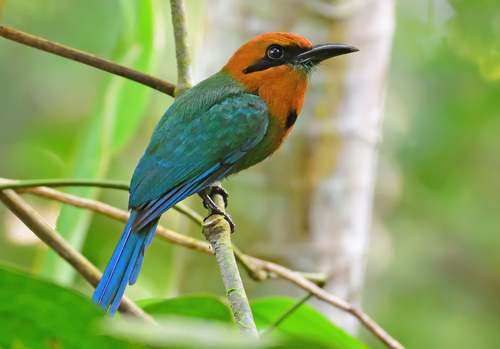
Broad-billed Motmot
Electron platyrhynchum
A master of the tropical mid-story, the Broad-billed Motmot is easily recognized by its vibrant cinnamon plumage and iconic racket-tipped tail. This patient hunter brings a splash of prehistoric elegance to the humid forests of the Americas.
Quick Identification
Size
Length: 30–35 cm (12–14 in); Weight: 55–70 g (1.9–2.5 oz)
Colors
Cinnamon-rufous head, neck, and breast; green upperparts and wings; turquoise-blue tail; black mask and chest spot
Key Features
- Distinctively wide, heavy bill with serrated edges
- Long tail with two central feathers ending in racket-shaped tips
- Vibrant rufous head and chest contrasting with green back
- Small black spot in the center of the breast
When You’ll See Them
Sightings on EverydayEarth
Jun 17, 2026
A Broad-billed Motmot lands on a mossy branch near the fruit feeder. It perches for several seconds, surveying the area and looking toward the camera, before flying out of the frame.
Geographic range
Where Does the Broad-billed Motmot Live?
Native to the lush tropical regions of Central and South America, the Broad-billed Motmot enjoys a vast range that spans from eastern Honduras down through the Amazon Basin. Its core populations are found throughout Nicaragua, Costa Rica, and Panama, extending south into Colombia, Ecuador, Peru, and northern Bolivia, as well as parts of western Brazil. This species is a lowland specialist, rarely straying far from the humid, evergreen corridors of the neotropics.
Basemap © OpenStreetMap contributors
Behavior
Socially, these birds are typically found alone or in pairs. They are highly territorial during the breeding season, which is when they are most vocal. One of their most fascinating behaviors is the rhythmic wagging of their racket-tipped tails when they detect a predator, a signal that likely tells the intruder they have been spotted and shouldn't bother attacking.
While they are forest specialists, they can become quite habituated to quiet human presence. They are not known for being particularly skittish, provided there is enough vertical cover. They nest in long burrows excavated into earthen banks, sometimes reaching over five feet in length, which they defend with quiet but firm persistence.
EverydayEarth exclusive
Camera Tips
To capture the Broad-billed Motmot on your backyard or trail camera, focus on the mid-story 'perch zones.' These birds prefer horizontal, open branches roughly 5 to 12 feet off the ground that provide a clear line of sight to the forest floor. Position your camera at eye-level with these branches, ideally 10-15 feet away to capture the full length of their impressive tail rackets without clipping the frame.
Because motmots are 'sit-and-wait' hunters, they can remain perfectly still for many minutes at a time. This can trick some motion-activated cameras into ending a recording too early. Set your camera to take longer video clips (30+ seconds) or use a 'High' sensitivity setting for motion triggers to catch the subtle tail-wagging or head-cocking that happens between strikes.
Lighting is your biggest challenge in the humid forest understory. Use a camera with a high-quality sensor capable of handling low-light conditions, as these birds thrive in the deep shade. If your camera allows for shutter speed adjustment, keep it fast; while the bird sits still, its strike at an insect is lightning-fast and will blur on slower settings. Avoid using a heavy flash, which can wash out the delicate cinnamon and green iridescent feathers.
If you live within their range, you can attract them to a camera site by maintaining a 'wild' area with thick leaf litter. This attracts the large beetles and lizards they crave. Additionally, if you have an earthen bank or a steep slope on your property, place a camera facing it during the spring months, as they may choose these sites for burrowing their nests.
Similar Species
Species that look similar or are commonly confused with Broad-billed Motmot.
Frequently Asked Questions
Record Broad-billed Motmot at your habitat
Connect a camera to start building your own species record — AI identifies every visitor automatically.