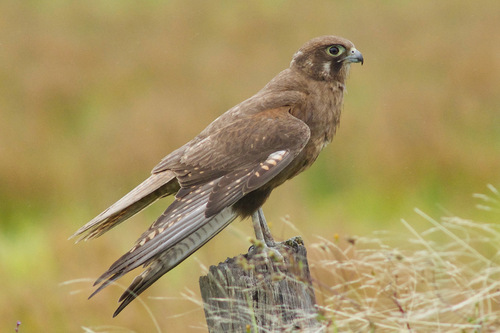
Brown Falcon
Falco berigora
A master of the Australian outback, the Brown Falcon is a unique raptor known for its distinctive cackle and its unusual habit of hunting on foot. Found across almost every corner of Australia, it is one of the most versatile and frequently spotted birds of prey for backyard observers.
Quick Identification
Size
Length: 40–50 cm (16–20 in); Wingspan: 80–115 cm (31–45 in); Weight: 315–860 g (0.7–1.9 lb)
Colors
Extremely variable plumage ranging from pale sandy-brown to soot-black; typically features dark 'tear' marks under the eyes and a pale throat.
Key Features
- Distinctive dark 'double' facial tear marks
- Broad, rounded wing tips compared to other falcons
- Long, unfeathered blue-grey legs
- Frequently perches on fence posts and power lines
When You’ll See Them
Geographic range
Where Does the Brown Falcon Live?
The Brown Falcon is a quintessential inhabitant of the Australasian region, found across the entire continent of Australia, including Tasmania. Beyond the Australian mainland, its range extends northward into the tropical savannas and open country of New Guinea and parts of Indonesia. It is one of the most widely distributed raptors in its range, thriving in almost every environment except for the densest rainforests and most urbanized city centers.
Basemap © OpenStreetMap contributors
Behavior
The Brown Falcon is often characterized by its somewhat sluggish and heavy flight compared to the high-speed aerial acrobatics of other falcon species. It is a highly vocal raptor, frequently emitting loud, raucous cackling or screeching calls that can be heard from a significant distance. Unlike many of its relatives, it is remarkably comfortable on the ground and can often be seen walking or running with agility while chasing large insects or lizards.
These birds are generally solitary or seen in pairs, though they are known to congregate in large numbers at food sources, such as during grasshopper plagues or at the edges of bushfires to catch fleeing prey. While they are bold hunters, they are relatively wary of direct human approach but have successfully adapted to life in agricultural landscapes where fence posts provide the perfect vantage points for their 'sit-and-wait' hunting style.
EverydayEarth exclusive
Camera Tips
To capture high-quality footage of a Brown Falcon, the most important factor is identifying their 'sentinel' perches. These birds are creatures of habit and will return to the same tall fence post, dead tree limb, or utility pole day after day to survey their territory. Position your camera approximately 5–6 feet high on an adjacent post or tree, angled slightly toward the falcon’s preferred perch. Because they are diurnal, you can save battery and SD card space by setting your camera to only operate during daylight hours.
While they aren't easily baited in the traditional sense, providing a reliable water source like a large, shallow bird bath can be a magnet for Brown Falcons, especially in rural or arid areas. Place the camera about 10–15 feet from the water source to ensure the entire bird stays within the frame when it spreads its wings. Use a fast trigger speed (0.2s to 0.5s) because even though they sit still for long periods, their take-off is sudden and rapid.
If you live on a property with livestock or mowed paddocks, set your cameras near areas of recent activity. Brown Falcons often follow tractors or livestock to catch the insects and small lizards stirred up by the movement. For the best visual results, ensure the camera faces south (in the Southern Hemisphere) to keep the sun behind the lens, which prevents the bird's intricate feather patterns from being lost in a silhouette. Use the highest resolution video setting available to help you distinguish between the light, intermediate, and dark morphs of this species.
Similar Species
Species that look similar or are commonly confused with Brown Falcon.
Nankeen Kestrel
Much smaller and slimmer with a reddish-brown back; has a more refined, stationary hover.
Black Falcon
Sleeker with more pointed wings; lacks the distinct 'double' tear mark and has shorter legs.
Peregrine Falcon
Features a heavy black hood and horizontal barring on the chest, with much faster, more direct flight.
Frequently Asked Questions
Record Brown Falcon at your habitat
Connect a camera to start building your own species record — AI identifies every visitor automatically.