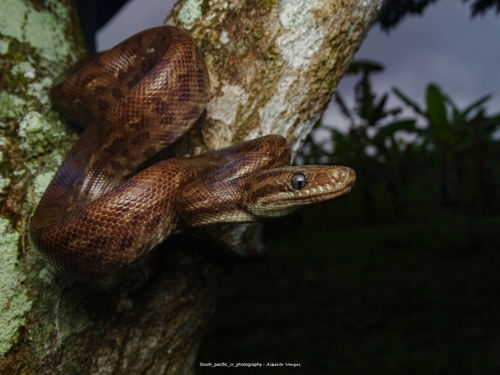
Brown Rainbow Boa
Epicrates maurus
The Brown Rainbow Boa is a master of subtle beauty, combining a chocolatey camouflage with a stunning prismatic shimmer that appears like oil on water.
Quick Identification
Size
Typically 4 to 6 feet (1.2 to 1.8 meters) in length and weighing 2 to 5 pounds (0.9 to 2.3 kg)
Colors
Base color of mahogany, tan, or chocolate brown with darker, often faded circular 'ocelli' or rings along the sides; spectacular rainbow iridescence visible in direct light.
Key Features
- Prismatic iridescence on scales when hit by light
- Dark circular markings or rings along the flanks
- Slender, muscular body with a distinct neck and head
- Heat-sensing pits located along the upper lip
When You’ll See Them
Geographic range
Where Does the Brown Rainbow Boa Live?
Native to the tropical regions of Central and South America, the Brown Rainbow Boa occupies a range that spans from southern Costa Rica and Panama into the northern Amazon basin. It is frequently found throughout Colombia, Venezuela, Trinidad and Tobago, and the Guianas, thriving in lowland areas below 1,000 meters. While they are most common in undisturbed forests, they have proven resilient in human-altered landscapes across their native territory.
Basemap © OpenStreetMap contributors
Behavior
The Brown Rainbow Boa is a primarily nocturnal hunter that balances its life between the forest floor and the lower canopy. While younger individuals are more inclined to stay in the trees to avoid ground-level predators, adults are semi-arboreal and frequently venture onto the ground to track rodent prey. They are exceptionally shy and secretive, relying on their earthy coloration to remain camouflaged in leaf litter during the daylight hours.
As non-venomous constrictors, they pose no significant threat to humans and are generally docile, though they may strike if cornered. In suburban environments, they are often seen as beneficial neighbors because they are highly efficient at controlling rodent populations. Unlike their flashier Brazilian cousins, Brown Rainbow Boas are more tolerant of varied humidity levels, making them a common sight in both dense jungles and drier scrublands.
EverydayEarth exclusive
Camera Tips
To capture a Brown Rainbow Boa on camera, focus your efforts on 'edge habitats' where forest meets clearings or water sources. These snakes often travel along the base of stone walls, fallen logs, or the edges of ponds where rodent activity is high. Place your camera 6 to 12 inches off the ground, angled slightly upward to capture the full body as they glide past. Because they are semi-arboreal, a second camera positioned 4 to 5 feet high on a sturdy tree trunk can often catch them climbing.
Since these boas are strictly nocturnal, a camera with high-quality No-Glow Infrared (IR) LEDs is essential. Standard white flash cameras will likely startle the snake and may cause it to avoid the area in the future. To maximize your chances, set your camera to 'Video Mode' with a 15-20 second clip length. Snakes move slowly, and a single still photo often only captures a tail or a blurry midsection. High-sensitivity PIR settings are necessary, but keep in mind that as cold-blooded animals, they may not trigger the camera unless they have recently been basking or if the ambient air temperature is significantly different from their body temperature.
While it is difficult to capture their signature rainbow iridescence at night, you can sometimes catch a glimpse of it during the 'golden hour' at dusk or dawn if the camera is positioned to catch the low sun. Placing a safe, natural lure like a small pile of brush or hollow logs nearby can encourage the snake to linger in the frame as it searches for a hiding spot or waits for prey. Avoid using food-based baits which may attract unwanted larger predators that could scare the boa away.
Frequently Asked Questions
Record Brown Rainbow Boa at your habitat
Connect a camera to start building your own species record — AI identifies every visitor automatically.