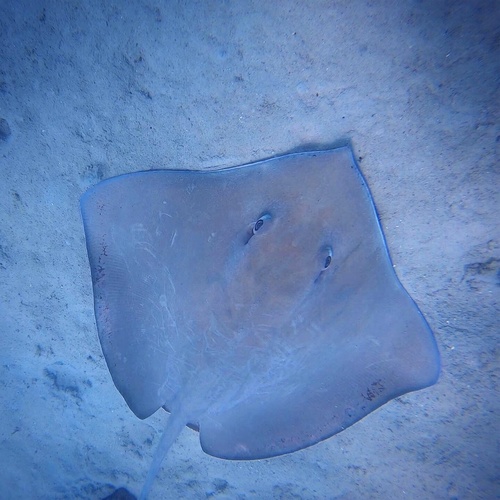
Brown Whipray
Maculabatis toshi
A ghostly glider of the northern mudflats, the Brown Whipray is a master of disguise and a vital part of the tropical estuarine ecosystem. Its long, whip-like tail and earthy tones make it an icon of Australia's shallow coastal waters.
Quick Identification
Size
Disc width up to 74 cm (29 in); total length including tail can reach 150 cm (59 in)
Colors
Upper surface is a uniform plain brown or grey-brown, occasionally with small white flecks near the edges. The underside is white, and the tail is dark with faint light bands toward the tip.
Key Features
- Angular, diamond-shaped pectoral fin disc
- Extremely long, thin whip-like tail without fin folds
- Uniformly brown dorsal surface with a starkly white underbelly
- Eyes and spiracles positioned prominently on top of the head
When You’ll See Them
Geographic range
Where Does the Brown Whipray Live?
The Brown Whipray is a tropical specialist native to the Indo-Pacific, with its primary stronghold located along the northern coastline of Australia. Its range spans from the Shark Bay region in Western Australia, across the Top End of the Northern Territory, and down the Queensland coast to at least the Brisbane River. While it is most concentrated in Australian waters, populations are also found in the shallow coastal reaches of southern Papua New Guinea.
Basemap © OpenStreetMap contributors
Behavior
The Brown Whipray is a master of coastal camouflage, typically spending its daylight hours partially submerged in the silt or sand of tropical estuaries. By using its pectoral fins to excavate a shallow depression, it can hide from predators while using its spiracles—specialized openings behind the eyes—to breathe while buried. This species is generally solitary and non-aggressive, though it possesses a venomous serrated spine at the base of its tail used strictly for self-defense if stepped on or cornered.
When the tide rises, the Brown Whipray becomes more active, gliding gracefully over the substrate in search of food. It utilizes a highly developed sense of electroreception to 'see' the electrical signatures of prey hidden beneath the mud. Although they are wary of sudden movements, they are known to frequent the same shallow 'resting' spots daily, making them predictable subjects for patient observers and well-placed underwater cameras.
EverydayEarth exclusive
Camera Tips
Capturing the Brown Whipray requires a specialized underwater approach. For those with waterfront property or access to estuaries, use a waterproof action camera or a dedicated underwater trail camera. The best placement is on a weighted 'flat-plate' mount set directly on the sandy or muddy bottom in about 1 to 2 meters of water. Position the lens horizontally or at a slight downward angle to capture the ray as it settles into the sediment. Look for 'ray pits'—shallow, circular depressions in the mud at low tide—which indicate where the animals frequently rest.
Since these rays rely heavily on their sense of smell and electroreception, a scent-based attractant is highly effective. Place a small, mesh bait bag filled with crushed oily fish or prawn shells approximately one meter in front of the camera lens. Secure the bait bag with a stake so the current doesn't move it out of the frame. The scent trail will encourage the ray to hover directly in front of your camera as it investigates the source of the smell with its sensitive underside.
Timing is everything when filming estuarine wildlife. Set your camera to record during the two hours surrounding high tide, as this is when the Brown Whipray moves into the shallows to forage. If your camera has a 'time-lapse' mode, this can be an excellent way to capture the slow process of the ray burying itself in the sand. For night footage, ensure your camera uses high-quality infrared LEDs; standard white light may startle the ray and cause a 'dust cloud' as it swims away rapidly, obscuring the shot.
Frequently Asked Questions
Record Brown Whipray at your habitat
Connect a camera to start building your own species record — AI identifies every visitor automatically.