buffalograss
Bouteloua dactyloides
The resilient heart of the American prairie, Buffalograss is a tough, low-growing native that creates a soft, drought-tolerant carpet for wildlife and sustainable backyards alike.
Quick Identification
Size
4-8 inches (10-20 cm) tall; stolons can spread 12-24 inches (30-60 cm) per season
Colors
Gray-green to blue-green foliage; turns golden-tan or straw-colored when dormant
Key Features
- Low-growing, sod-forming growth habit
- Curling, narrow leaf blades 1-2 mm wide
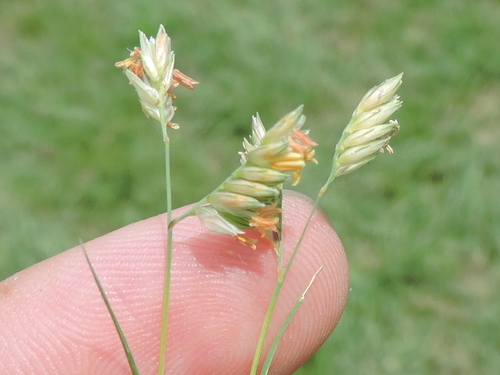
- Dioecious flowers: male plants have flag-like spikes, females have bur-like clusters hidden near the soil
- Spreads via vigorous above-ground runners (stolons)
When You’ll See Them
Geographic range
Where Does the buffalograss Live?
Native to the vast central corridor of North America, Buffalograss is the quintessential plant of the Great Plains. Its core range extends from the southern provinces of Canada, such as Saskatchewan and Manitoba, down through the central United States to the plateau regions of central Mexico. It is most dominant in the 'High Plains' regions where rainfall is scarce, though it has been successfully introduced as a sustainable turf option in arid regions across the Western United States.
Basemap © OpenStreetMap contributors
Behavior
Buffalograss is a remarkably resilient perennial grass that defines the shortgrass prairie. Unlike many taller grasses, it stays low to the ground, focusing its energy on lateral growth through stolons. This creates a dense, carpet-like mat that is exceptionally efficient at holding soil in place and resisting foot traffic. It is a warm-season species, meaning it thrives in the heat of summer and enters a protective dormancy during the winter months, turning a characteristic golden hue.
As a dioecious species, Buffalograss exhibits a fascinating reproductive strategy where male and female flowers typically grow on separate plants. The male flowers are elevated on thin stalks, looking like tiny flags catching the wind to disperse pollen, while the female flowers are tucked away near the base of the plant to protect the developing seeds. In a backyard setting, it behaves as a low-maintenance, drought-tolerant lawn alternative that requires significantly less water and mowing than traditional turfgrasses.
EverydayEarth exclusive
Camera Tips
Capturing the subtle beauty of Buffalograss requires a different approach than filming mobile wildlife. To showcase its growth, set your AI camera to a time-lapse mode during the late spring. Position the camera on a low tripod or ground mount, focusing on a specific patch where stolons (runners) are visible. Over a period of several weeks, you can capture the 'creeping' behavior as the grass colonizes bare soil.
For those interested in the 'micro-wildlife' that inhabits the grass, use a macro lens or a close-up setting. Aim the camera at the male flower spikes—the little 'flags'—during a breezy day to capture their movement, or look low into the thatch to find the female burs. Because Buffalograss is a hub for pollinators and ground-dwelling insects, these close-up shots often catch unexpected visitors like grasshoppers or native bees.
If you are using your camera to monitor backyard health, place the camera at a 45-degree angle facing North to avoid lens flare. This allows you to monitor the color transition from dormancy to active growth. The dense mat of Buffalograss is also a favorite foraging spot for birds like Horned Larks or various sparrows; setting your camera's motion trigger to 'high' at ground level will help you catch these quick-moving visitors as they hunt for seeds or insects within the grass blades.
Similar Species
Species that look similar or are commonly confused with buffalograss.
Frequently Asked Questions
Record buffalograss at your habitat
Connect a camera to start building your own species record — AI identifies every visitor automatically.