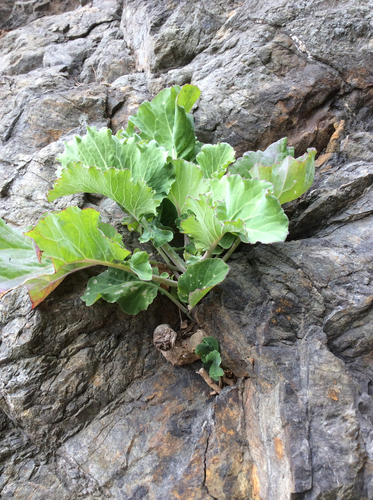
cabbage, broccoli, and allies
Brassica oleracea
The ultimate garden chameleon, Brassica oleracea is the ancestor of everything from kale to cauliflower. This resilient survivor has traveled from European sea cliffs to become the most important plant in your backyard ecosystem.
Quick Identification
Size
Height of 30-100 cm (1-3.3 ft); spread of 30-90 cm (1-3 ft) depending on the cultivar
Colors
Waxy blue-green, vibrant emerald, or deep purple foliage; small four-petaled yellow flowers when in bloom
Key Features
- Thick, glaucous (waxy) leaves with a characteristic blue-gray cast
- Dense, central growth habit forming heads, florets, or thick stems
- Robust, woody base in older plants
- Characteristic four-petaled 'cruciform' yellow flowers
When You’ll See Them
Geographic range
Where Does the cabbage, broccoli, and allies Live?
Originally native to the coastal limestone cliffs of Southern and Western Europe, Brassica oleracea is one of the most widely traveled plants in human history. It thrives in the temperate maritime climates of the United Kingdom, France, and Spain in its wild form. Through centuries of cultivation, it has been introduced to almost every corner of the globe, with massive populations now established across North America, Asia, and Australia, where it is a staple of both backyard gardens and industrial agriculture.
Basemap © OpenStreetMap contributors
Behavior
Brassica oleracea is a highly versatile biennial plant that behaves differently depending on its stage of life and the specific cultivar. In its first year, the plant focuses entirely on vegetative growth, storing energy in its thick leaves or stems to survive the winter. This is the stage where we recognize it as cabbage, broccoli, or kale. If left to grow into its second year, the plant undergoes a dramatic transformation called 'bolting,' where it sends up a tall, branched stalk covered in bright yellow flowers to attract pollinators.
As a neighbor in the garden, this species is a hub of biological activity. It has evolved a complex relationship with the environment, producing sulfur-rich compounds (glucosinolates) that act as a natural defense against many herbivores but actually attract specific 'specialist' insects. While it appears stationary, the plant is constantly responding to light and moisture, with its waxy leaves cleverly designed to funnel rainwater directly toward the central taproot.
EverydayEarth exclusive
Camera Tips
Capturing the life of Brassica oleracea requires a shift in mindset from traditional wildlife photography. The most rewarding technique is time-lapse photography. Set your AI-powered camera to take a still image every 4 to 6 hours. Over several weeks, you will see the incredible 'slow-motion' movement of the leaves as they expand and the central head of a cabbage or broccoli tightening. Ensure the camera is mounted on a very stable stake or tripod, as even a small nudge will ruin the alignment of your time-lapse sequence.
Because these plants are magnets for insects, they are excellent 'stations' for macro wildlife photography. Position your camera at a close-focus distance (typically 1.5 to 3 feet depending on your lens) and aim for a 45-degree downward angle. This setup is perfect for catching Cabbage White butterflies (Pieris rapae) as they land to lay eggs, or ladybugs hunting for aphids among the leaves. Use a high trigger sensitivity and a fast shutter speed to freeze the motion of visiting pollinators.
Pay close attention to lighting to make the foliage 'pop.' The glaucous, waxy coating on the leaves creates a beautiful matte texture that can look flat in midday sun. The best images are captured during the 'blue hour' just before sunrise or after sunset, or immediately after rain. The 'lotus effect' on the leaves causes water to bead into perfect spheres; using a side-angle flash or a reflected light source can make these water droplets look like crystals on your camera feed.
Frequently Asked Questions
Record cabbage, broccoli, and allies at your habitat
Connect a camera to start building your own species record — AI identifies every visitor automatically.