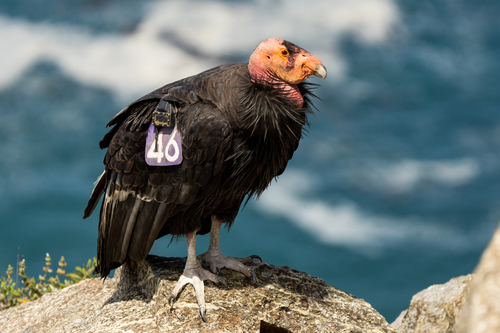
California Condor
Gymnogyps californianus
Witness the return of a prehistoric giant. With a ten-foot wingspan and a remarkable survival story, the California Condor is the undisputed king of the Western skies.
Quick Identification
Size
Length: 109–140 cm (43–55 in); Wingspan: 2.7–3.0 m (8.9–9.8 ft); Weight: 7–14.1 kg (15.4–31.1 lb)
Colors
Adults are mostly black with prominent white triangular patches on the underside of the wings; heads are bald with skin ranging from yellowish to bright orange-red. Juveniles have darker, gray heads and lack the white wing patches.
Key Features
- Massive 9-10 foot wingspan
- White triangular patches on underwings (adults)
- Bald head with pink/orange skin
- Long, finger-like primary feathers in flight
When You’ll See Them
Sightings on EverydayEarth
Jun 29, 2026
Two California Condors are perched on a tall, bleached snag overlooking the coastal hills of Big Sur. The individual at the very top of the tree periodically turns its head to survey the valley, while a second bird sits lower on a branch in the background. The scene is illuminated by bright midday sun under a clear blue sky.
Jun 29, 2026
Several California Condors are gathered around a small rocky pool. Two birds stand prominently near the water, displaying large numbered wing tags used for conservation monitoring. One bird rests on the rocks in the foreground, while others are seen perching or moving on the dry, grassy hillside in the background.
Jun 29, 2026
A large congregation of California Condors is gathered at a rocky feeding station. The birds are seen walking and hopping across the dry ground, with several individuals actively pecking at the earth. Many of the condors are wearing large, brightly colored wing tags with visible numbers, used by biologists to monitor this endangered species.
Jun 29, 2026
Under a clear sky, two large birds are perched on a prominent dead tree snag. A Common Raven is perched on a thin branch to the right, occasionally shifting its position. Lower down on the main trunk, a significantly larger California Condor remains still in a hunched roosting posture, overlooking the mountainous terrain of Big Sur.
Jun 29, 2026
Two California Condors are perched on the stark, bleached branches of a dead tree snag. They sit overlooking the dry, sun-bleached hills of Big Sur under a clear blue sky, occasionally turning their heads to scan the surrounding landscape.
Jun 29, 2026
A group of California Condors is seen at a sanctuary site. One individual perches on a wooden beam in the foreground, while several others are perched atop a large mesh enclosure in the background. The birds appear calm, occasionally shifting their positions and looking around the dry, grassy hillside in the bright afternoon sun.
Geographic range
Where Does the California Condor Live?
Native to the wild landscapes of North America, the California Condor's presence is a testament to intensive conservation efforts across the Western United States and Northern Mexico. These majestic birds are currently found in localized populations within the coastal mountains of California, the rugged canyons of northern Arizona and southern Utah near the Grand Canyon, and the mountainous regions of Baja California. They thrive in open territories where they can utilize rising thermals to traverse hundreds of miles in search of food, often spanning multiple habitats from sea-level cliffs to high-altitude forests.
Basemap © OpenStreetMap contributors
Behavior
California Condors are highly social and intelligent scavengers that spend the majority of their day soaring on thermal updrafts in search of carrion. They are master gliders, capable of traveling up to 150 miles in a single day without flapping their wings. Because they lack a syrinx (vocal organ), their communication is limited to a variety of grunts, wheezes, and hisses, often accompanied by complex body language and changes in head color during social interactions.
These birds are meticulous about hygiene and will spend hours preening their feathers or bathing in pools after feeding. In the wild, they exhibit a strict social hierarchy, with dominant birds feeding first at a carcass. While they are naturally curious, they are generally shy around human activity, though they have been known to investigate campsites or shiny objects in their environment.
EverydayEarth exclusive
Camera Tips
To capture a California Condor on camera, location is everything. These birds are master gliders, so positioning your camera on high-elevation ridgelines or near steep cliffs where thermals are strongest increases your chances of a fly-by. If you live in or near a reintroduction zone, look for prominent, dead 'snag' trees which they use for communal roosting; a camera angled upward at these branches can capture stunning images of them preening or stretching their massive wings at dawn.
Water sources are another high-traffic area. In the arid environments of the Southwest, condors will frequently visit remote cattle tanks or natural springs to drink and bathe. Place your camera at a height of about 3 to 4 feet, angled slightly downward toward the water's edge. Because condors are social, you might capture multiple individuals interacting, but ensure your camera has a wide-angle lens to accommodate their nearly 10-foot wingspan.
Patience and timing are critical. Condors are strictly diurnal, meaning they are active only during daylight hours, typically waiting until the sun warms the air enough to create soaring currents, usually between 10 AM and 4 PM. Set your camera to a burst mode or high-speed trigger to catch them in motion. Remember to never use food as bait, as these birds are strictly monitored and sensitive to human-introduced lead; instead, rely on natural movement patterns through their known foraging corridors.
Similar Species
Species that look similar or are commonly confused with California Condor.
Frequently Asked Questions
Record California Condor at your habitat
Connect a camera to start building your own species record — AI identifies every visitor automatically.