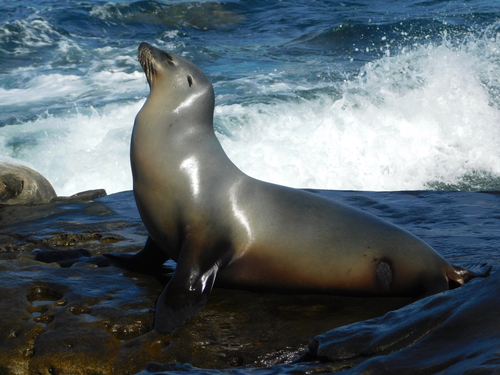
California Sea Lion
Zalophus californianus
The athletic 'sentinel of the shore,' the California Sea Lion is a social powerhouse known for its loud barks and incredible agility both in the water and on the docks.
Quick Identification
Size
Males reach 2.4 meters (7.9 ft) and 350 kg (770 lb); females reach 1.8 meters (6 ft) and 100 kg (220 lb).
Colors
Adult males are dark chocolate brown to black; females and juveniles are lighter tan or golden brown.
Key Features
- Pronounced sagittal crest (forehead bump) in adult males
- Visible external ear flaps
- Large, powerful front flippers used for 'walking' on land
- Distinctive, loud barking vocalization
When You’ll See Them
Sightings on EverydayEarth
Mar 29, 2026
Two California sea lions swim gracefully through the amber kelp forest. One individual swims directly toward the camera, providing a close-up view of its head and flippers as it ascends toward the surface.
Geographic range
Where Does the California Sea Lion Live?
Native to the eastern Pacific Ocean, the California Sea Lion is a staple of the North American coastline. Their range spans from the chilly waters of Southeast Alaska and British Columbia down through the entire western United States, reaching the warm subtropical lagoons of Baja California and the Gulf of California in Mexico. While they are most concentrated in California during the summer breeding season, adult males often migrate as far north as Canada and Alaska during the winter months.
Basemap © OpenStreetMap contributors
Recorded on EverydayEarth
Behavior
California Sea Lions are remarkably social and intelligent animals, famous for their playful antics and high level of vocalization. They are gregarious creatures that spend much of their time 'hauling out' in large communal groups on sandy beaches, rocky jetties, or man-made structures like marina docks and navigation buoys. In the water, they are incredibly agile, capable of reaching speeds of up to 25 miles per hour and diving to depths of nearly 900 feet to find food.
While they are opportunistic hunters, their social structures are most visible during the breeding season when dominant 'beach masters' defend territories through barking and physical posturing. Outside of the breeding season, they are known for their curiosity and often interact with human environments. They have a well-documented history of following fishing vessels or congregating in urban harbors, where they have become a major tourist attraction despite their sometimes boisterous and territorial nature.
EverydayEarth exclusive
Camera Tips
Capturing the California Sea Lion requires gear that can withstand harsh coastal environments. If you are setting up a camera near a private dock or shoreline, the primary challenge is salt corrosion. Always use a marine-grade housing or a protective silicone skin for your camera, and ensure your mounting hardware is stainless steel or heavy-duty plastic. Position the camera about 3 to 5 feet above the ground or dock surface, angling it slightly downward to capture the 'hauling out' behavior where they transition from water to land.
For the best action shots, use a camera with a very fast trigger speed (0.3 seconds or less). Sea lions are surprisingly fast when they 'porpoise' out of the water or squabble for space on a dock. Set your camera to 'Burst Mode' to capture a series of images, which increases your chances of getting a clear shot of a bark or a mid-air leap. Because their wet fur can be highly reflective, try to position the camera so the sun is behind it to avoid lens flare and 'blown-out' white spots on the animal's back.
While many wildlife species require bait, you should never bait California Sea Lions. It is illegal under the Marine Mammal Protection Act and can lead to dangerous habituation. Instead, leverage their natural social habits by aiming your camera at high-traffic 'haul-out' spots like the ends of finger piers or flat, sun-exposed rock shelves. If you are monitoring at night, ensure your camera has a strong No-Glow IR flash, as sea lions are often active in the dark and standard white flashes can startle them or cause 'eye shine' that ruins the image detail.
Similar Species
Species that look similar or are commonly confused with California Sea Lion.
Frequently Asked Questions
Record California Sea Lion at your habitat
Connect a camera to start building your own species record — AI identifies every visitor automatically.