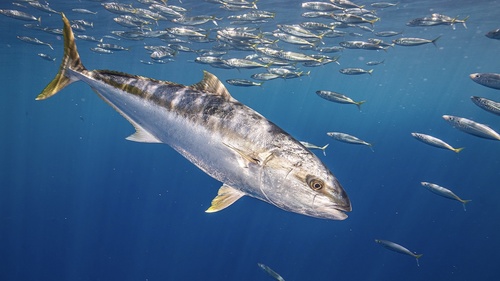
California Yellowtail
Seriola dorsalis
The California Yellowtail is the golden prize of the Pacific, a high-speed predator that thrives in the kelp forests of the West Coast. With its brilliant yellow stripe and incredible power, it is an icon of the California current.
Quick Identification
Size
90–150 cm (35–60 inches) in length; typically 5–18 kg (10–40 lbs), though trophy specimens can exceed 36 kg (80 lbs).
Colors
Metallic blue or olive-green back, silvery-white belly, and a signature brassy-yellow horizontal stripe along the midline; tail and fins are bright yellow.
Key Features
- Distinctive yellow horizontal stripe from eye to tail
- Bright yellow, deeply forked caudal fin (tail)
- Streamlined, torpedo-shaped body for high-speed swimming
- Small, smooth scales with a metallic sheen
When You’ll See Them
Geographic range
Where Does the California Yellowtail Live?
Where Does the California Yellowtail Live? This species is native to the Eastern Pacific Ocean, primarily concentrated along the western coast of North America. Its core range extends from the temperate waters of Southern California in the United States down the entire length of the Baja California peninsula in Mexico, including the prolific waters of the Gulf of California. While they are most abundant in these regions, they are known to wander as far north as British Columbia during unusually warm El Niño events.
Basemap © OpenStreetMap contributors
Behavior
The California Yellowtail is a powerful, schooling predator known for its incredible speed and stamina. These fish are highly social and are often found in large groups patrolling the edges of kelp forests, rocky reefs, and offshore banks. They are opportunistic hunters that use their speed to ambush baitfish, often driving their prey toward the surface in a display known as a 'boil.'
As a coastal pelagic species, they are highly sensitive to water temperature. They migrate seasonally, following warm-water currents as they push northward during the summer and retreating south as the ocean cools in the winter. In their interactions with humans, they are celebrated as one of the premier game fish of the Pacific, prized for their strength and the challenge they provide to coastal observers and anglers alike.
EverydayEarth exclusive
Camera Tips
Capturing the California Yellowtail on camera requires an underwater setup, as these fish never leave the water. If you live on the coast or have access to a pier, a submersible action camera or a 'drop camera' tethered to a dock is your best tool. Position your camera near 'structure'—such as kelp stalks, pier pilings, or rocky ledges—where Yellowtail are likely to cruise in search of prey.
Because these are fast-moving fish, motion blur is your biggest enemy. Set your camera to a high frame rate, at least 60fps or 120fps, to ensure their rapid movements remain crisp. If you are shooting in the clear, sunlit waters of Southern California or Baja, use a red filter to help bring back the natural colors that get lost underwater, highlighting the brilliant yellow stripe that gives the species its name.
To bring the action to your lens, you can use a 'teaser'—a shiny, hookless lure or a chrome spoon—suspended in front of the camera. The flash mimics the scales of a fleeing baitfish and will often entice a curious Yellowtail to circle the camera for a close-up. Early morning is the best time for filming, as the 'grey light' period is when these fish are most actively hunting near the surface.
Frequently Asked Questions
Record California Yellowtail at your habitat
Connect a camera to start building your own species record — AI identifies every visitor automatically.