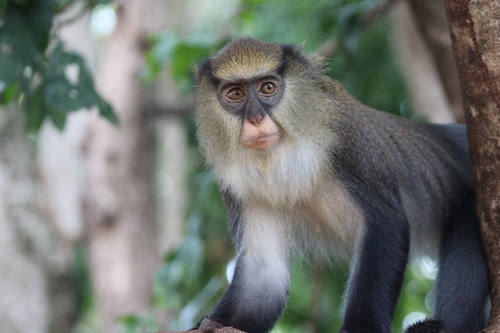
Campbell's Monkey
Cercopithecus campbelli
The Campbell's Monkey is a master of the West African canopy, known for its complex 'language' and striking white brow. This adaptable primate is as comfortable in a suburban garden as it is in the deepest rainforest.
Quick Identification
Size
Head and body length of 35-55 cm (14-22 in) with a tail reaching 55-85 cm (22-33 in); weighs 2.7-6 kg (6-13 lbs).
Colors
Olive-grey or grizzled greenish-brown back with pale yellowish-white underparts; dark limbs and a distinctive white or yellowish brow band.
Key Features
- Prominent yellowish-white brow band (diadem) above the eyes
- Long, dark tail significantly longer than the body
- Grizzled olive-greenish coat that blends into forest shadows
- Blue-grey skin visible around the eyes and muzzle
When You’ll See Them
Geographic range
Where Does the Campbell's Monkey Live?
Native to the coastal regions of West Africa, Campbell's Monkey occupies a lush geographic belt that stretches from the Casamance region of Senegal and the Gambia southward. Its core population resides within the Upper Guinean forests of Guinea, Sierra Leone, Liberia, and the Ivory Coast, extending as far east as the Volta River in Ghana. While they are forest-dependent, they are frequently spotted in the agricultural mosaics and wooded outskirts of major West African towns.
Basemap © OpenStreetMap contributors
Behavior
Campbell's monkeys are highly social and intelligent primates that live in groups typically consisting of one dominant male and several females with their offspring. They are famous among primatologists for their complex vocal communication; they use a sophisticated system of 'suffixes' to modify calls, allowing them to distinguish between different types of predators like eagles or leopards and even indicate the level of urgency.
These monkeys are primarily arboreal, spending most of their time in the mid-to-upper canopy where they move with incredible agility. However, they are notably adaptable and will frequently descend to the ground to forage or travel between forest patches. While they can be shy in areas with high human hunting pressure, they are known to become quite bold in protected areas or suburban fringes where they have become habituated to human presence.
EverydayEarth exclusive
Camera Tips
To capture high-quality footage of Campbell's monkeys, camera placement is critical. While they are arboreal, they often use 'corridors' or low-hanging branches to move between feeding sites. Mount your camera 5 to 10 feet up a tree trunk, angled slightly downward toward a known fruit tree or a gap in the canopy they are likely to jump across. If your camera is in a backyard setting, focus on the edges where dense brush meets open lawn, as they often pause there to scout for danger before moving.
Use a camera with a very fast trigger speed (under 0.5 seconds). These monkeys move quickly and erratically; a slow trigger will often result in a 'ghost' or just a tail leaving the frame. Setting your device to record short 15-20 second video clips is far more rewarding than still photos, as it allows you to observe their complex social grooming and hear their unique alarm calls.
Since they are most active in the low-light hours of early morning and late afternoon, ensure your camera has high-quality IR (Infrared) sensors. 'No-Glow' or 'Black Flash' models are highly recommended; Campbell's monkeys are incredibly perceptive and a visible red glow from a standard IR flash may cause them to avoid that specific tree in the future. If you are monitoring a specific fruiting tree like a wild fig or oil palm, place the camera on a neighboring tree about 15 feet away to capture the full range of their acrobatic feeding behavior.
Similar Species
Species that look similar or are commonly confused with Campbell's Monkey.
Frequently Asked Questions
Record Campbell's Monkey at your habitat
Connect a camera to start building your own species record — AI identifies every visitor automatically.