Canada mayflower
Maianthemum canadense
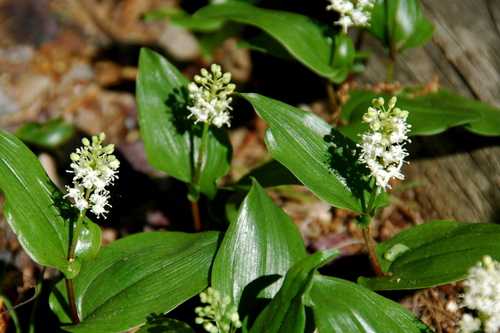
Often called 'Wild Lily-of-the-Valley,' this charming forest dweller blankets the woodland floor with glossy heart-shaped leaves and delicate white stars. It is a hallmark of the northern spring, providing vital nectar for pollinators and bright red berries for forest wildlife.
Quick Identification
Size
Height: 5–20 cm (2–8 inches); Leaves: 3–10 cm (1.2–4 inches) long
Colors
Glossy deep green leaves; creamy white flowers; berries that transition from spotted green to dull ruby red
Key Features
- Shiny heart-shaped leaves with distinct parallel veins
- Clusters of small white 4-petaled flowers
- Low-growing, often forming a dense groundcover
- Red berries produced in late summer
When You’ll See Them
Geographic range
Where Does the Canada mayflower Live?
Native to the vast temperate and boreal regions of North America, the Canada mayflower is a true northern specialist. Its range spans the continent from the Yukon and British Columbia in the west, all the way to Newfoundland and Labrador in the east. In the United States, it is a common sight throughout the Northeast and Great Lakes regions, extending southward through the high elevations of the Appalachian Mountains into Georgia.
Basemap © OpenStreetMap contributors
Behavior
During the late spring, the plant becomes a hub of activity for early-season pollinators. Its fragrant, nectar-rich flowers are specifically adapted to attract small bees and flower flies. As the season turns to autumn, the plant shifts its energy into fruit production. The resulting berries are a critical food source for woodland creatures, helping the plant disperse its seeds throughout the ecosystem as animals forage before the winter freeze.
EverydayEarth exclusive
Camera Tips
To capture the Canada mayflower effectively, you must adjust your camera for macro-style photography. Because these plants sit very low to the ground, use a ground stake or a beanbag to position your camera just 3 to 5 inches above the forest floor. Angle the lens slightly upward to capture the underside of the flowers and the texture of the leaves. If your AI-powered camera has a manual focus or a 'near' focus mode, ensure it is set to emphasize the foreground to prevent the camera from focusing on distant trees.
Since plants do not move enough to trigger standard PIR motion sensors, the 'Time-Lapse' feature is your best friend. Set the camera to take a photo every 30 minutes during the blooming period in late May. This will allow you to see the 'movement' of the leaves as they track the sun and the rapid opening of the flower spikes. For the best lighting, avoid the harsh midday sun which creates hot spots on the glossy leaves; instead, focus on the soft, diffused light of early morning or overcast days.
If you want to capture the wildlife that interacts with Canada mayflower, place the camera near a large 'carpet' of the plants during late August. Set the trigger sensitivity to 'High' to catch the small movements of chipmunks, mice, and ground-feeding birds like thrushes as they come to feast on the ripening red berries. Ensure the area directly in front of the lens is clear of stray blades of grass that might cause false triggers in the wind.
Frequently Asked Questions
Record Canada mayflower at your habitat
Connect a camera to start building your own species record — AI identifies every visitor automatically.