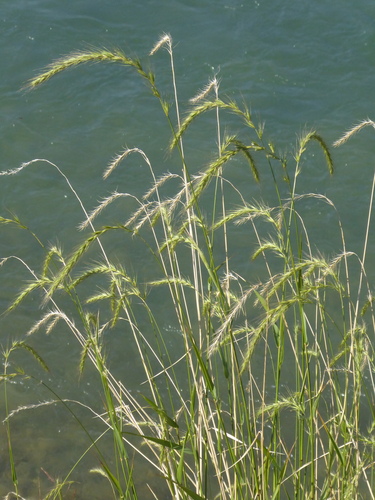
Canada wild rye
Elymus canadensis
Defined by its elegant, nodding seed heads and shaggy appearance, Canada wild rye is a cornerstone of the North American prairie. This fast-growing native grass provides essential shelter and food, making it a magnet for backyard wildlife.
Quick Identification
Size
Stands 2 to 5 feet (0.6 to 1.5 meters) tall with seed heads 4 to 10 inches (10 to 25 cm) long
Colors
Blue-green to silvery-gray foliage turning golden-tan to light brown as it matures
Key Features
- Distinctive nodding or curved flower spikes
- Long, bristly awns (up to 1.5 inches) giving a shaggy look
- Waxy, glaucous coating on the leaves and stems
- Short-lived perennial bunchgrass growth habit
When You’ll See Them
Geographic range
Where Does the Canada wild rye Live?
Canada wild rye is broadly distributed across North America, stretching from the southern reaches of Alaska and across nearly all Canadian provinces into the United States. Its core population is centered in the Great Plains and Midwest, but it thrives as far south as northern Mexico. Because it is highly adaptable to various moisture levels and soil types, it is a frequent sight in both the arid central basins and the humid eastern forests.
Basemap © OpenStreetMap contributors
Behavior
Canada wild rye is a hardy, cool-season perennial grass known for its rapid growth in the early spring. Unlike many other native grasses that take years to establish, this species acts as a pioneer, quickly colonizing disturbed soils and providing immediate cover. It is a bunchgrass, meaning it grows in discrete clumps rather than forming a uniform sod, which creates small 'wildlife highways' between the plants for insects and small mammals.
As the season progresses into mid-summer, the plant develops its iconic heavy seed heads. These spikes eventually become so heavy with grain that they curve downward, giving the plant its characteristic 'nodding' appearance. This physical structure is vital for local ecosystems, as the arching stems provide a canopy for ground-nesting birds and the seeds offer a high-energy food source that persists into the colder months.
EverydayEarth exclusive
Camera Tips
Capturing Canada wild rye on an AI-powered backyard camera is less about the plant itself and more about the diverse wildlife it draws into the frame. To get the best shots, position your camera at a low angle, roughly 12 to 18 inches off the ground, pointed toward a healthy clump of the grass. This perspective allows you to capture ground-feeding birds like dark-eyed juncos and song sparrows as they forage for fallen seeds, as well as small mammals seeking shelter in the thick foliage. Because the heavy seed heads tend to 'nod' or droop, they create a natural arch that frames subjects beautifully.
Wind is your biggest challenge and your best friend. The swaying motion of Canada wild rye can trigger some PIR sensors repeatedly, potentially draining your battery. To mitigate this, use a camera with adjustable sensitivity or set a short 'cool-down' period between triggers. Conversely, the movement of the grass makes for stunning high-definition video; if your camera supports it, enable 60fps video to capture the fluid, rhythmic motion of the stalks in the breeze, which adds a professional, cinematic quality to your backyard footage.
Lighting is critical for making this species pop. The leaves have a waxy, glaucous coating that can appear almost silvery or blue under the right conditions. Set your camera to face away from the direct path of the sun to avoid washing out these subtle colors. During the 'golden hour'—just before sunset—the dry, tan seed heads of late summer catch the light and glow brilliantly. If you're using a camera with infrared night vision, the dense stalks provide high-contrast textures that help you see exactly where nocturnal visitors like rabbits or foxes are moving through your yard.
Similar Species
Species that look similar or are commonly confused with Canada wild rye.
Frequently Asked Questions
Record Canada wild rye at your habitat
Connect a camera to start building your own species record — AI identifies every visitor automatically.