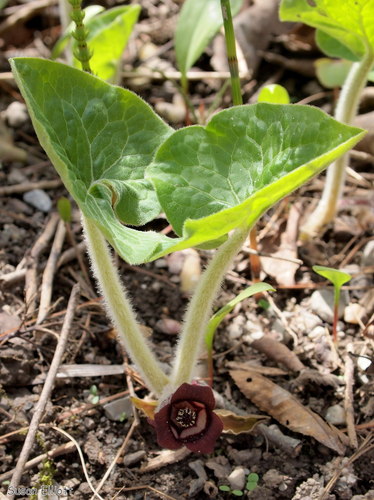
Canadian wild ginger
Asarum canadense
A secretive treasure of the North American woodland, Canadian wild ginger blankets the forest floor with velvety heart-shaped leaves and hides its strange, maroon blooms right at your feet.
Quick Identification
Size
Height of 10–20 cm (4–8 in); leaves spread 7–15 cm (3–6 in) wide
Colors
Soft, matte-green foliage; flowers are dark maroon, brownish-purple, or madder-red
Key Features
- Paired, velvety, heart-shaped leaves
- Single bell-shaped flower hidden at ground level
- Hairy stems and leaf undersides
When You’ll See Them
Geographic range
Where Does the Canadian wild ginger Live?
North America is the native home of the Canadian wild ginger, where it serves as a staple of the eastern deciduous forests. Its range is expansive, stretching from New Brunswick and southern Quebec in Canada, all the way down to the mountains of Georgia in the United States. It is commonly found as far west as the Great Plains, spanning through Minnesota, Iowa, and eastern Kansas, thriving wherever there is sufficient shade and consistent soil moisture.
Basemap © OpenStreetMap contributors
Behavior
The plant exhibits a fascinating relationship with the local environment. Because its flowers are located at the soil surface, it doesn't rely on bees or butterflies for pollination. Instead, it attracts ground-crawling insects like beetles and fungus gnats. Furthermore, it engages in a symbiotic relationship with ants; the seeds have a fatty attachment called an elaiosome that ants love. The ants carry the seeds to their nests, eat the snack, and effectively 'plant' the ginger in a new location.
EverydayEarth exclusive
Camera Tips
Lighting is your biggest challenge in the deep shade where this plant thrives. If you are using a trail camera, look for one with a high-quality 'No-Glow' flash or adjustable exposure settings to prevent the velvety leaves from looking washed out. Natural, dappled sunlight in the early morning (between 8:00 AM and 10:00 AM) provides the best texture-revealing light for the plant's fuzzy stems and leaves.
For those interested in the 'wildlife' aspect of this plant, set your camera to time-lapse mode or a high-sensitivity video trigger during May. You might capture the fascinating sight of ants carrying the seeds away or beetles crawling into the jug-like flowers. Since the plant is stationary, use a macro lens if possible to highlight the fine white hairs that cover the plant, which are designed to deter larger herbivores but look stunning on high-definition displays.
Frequently Asked Questions
Record Canadian wild ginger at your habitat
Connect a camera to start building your own species record — AI identifies every visitor automatically.