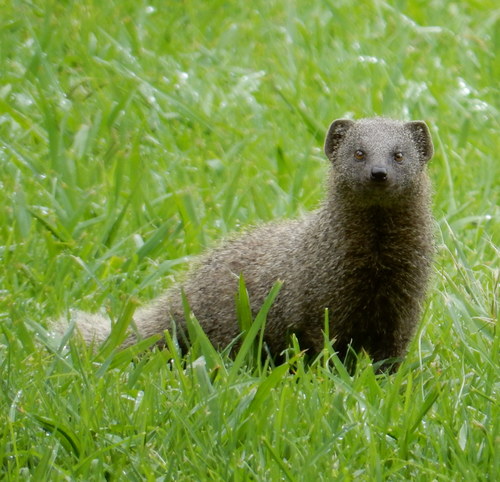
Cape Grey Mongoose
Herpestes pulverulentus
A sleek, solitary hunter of the South African landscape, the Cape Grey Mongoose is a master of adaptation. Easily identified by its grizzled 'peppered' coat, this agile carnivore is a frequent and helpful visitor to backyard gardens.
Quick Identification
Size
Body length 30–45 cm (12–18 in), tail 20–35 cm (8–14 in); weight 0.5–1.0 kg (1.1–2.2 lbs)
Colors
Uniformly grizzled grey with a peppered appearance; legs are typically a darker shade of grey; tail is bushy with a darker, though not distinctly black, tip.
Key Features
- Uniform silvery-grey grizzled coat
- Long, bushy tail held horizontally when running
- Small, low-slung profile with a pointed snout
- Diurnal (active during the day) and usually solitary
When You’ll See Them
Geographic range
Where Does the Cape Grey Mongoose Live?
Native to the southern tip of the African continent, the Cape Grey Mongoose is most commonly found throughout South Africa, with its core population residing in the Western and Eastern Cape provinces. Its geographic reach extends northwards into the southern regions of Namibia and the mountainous terrain of Lesotho. This resilient species thrives in a variety of landscapes, from coastal scrublands and fynbos to the arid interior, making it one of the most widely distributed small carnivores in the region.
Basemap © OpenStreetMap contributors
Behavior
The Cape Grey Mongoose is a predominantly solitary and highly active mammal. Unlike its more social relatives, it prefers to hunt alone, using its keen senses to detect movement in the undergrowth. They are incredibly agile and are often seen as a quick grey flash darting across roads or through garden shrubbery. While they are primarily terrestrial, they are capable climbers and will occasionally scale trees or garden walls to escape predators or seek out bird nests.
In suburban environments, these mongooses have become remarkably bold and well-adapted. They use garden hedges, storm drains, and rockeries as 'wildlife corridors' to navigate human-dominated landscapes safely. They are generally wary of humans and will bolt for cover if spotted, but they have learned to take advantage of the high densities of garden pests, such as snails and mice, making them a welcome sight for many South African gardeners.
EverydayEarth exclusive
Camera Tips
To capture the best footage of a Cape Grey Mongoose, place your camera at a very low height—ideally between 15 and 20 centimeters (6-8 inches) off the ground. These animals have a very low profile, and a camera mounted too high will often only capture their backs. Target 'edge' habitats in your yard, such as the line where a flower bed meets a wall or along a thick hedge, as they prefer to move through areas where they can quickly dive into cover.
Since these mongooses are strictly diurnal (day-active), shutter speed and trigger time are more important than night vision capabilities. Use a camera with a fast trigger speed (under 0.4 seconds) and set it to 'Burst Mode' or short video clips. They are incredibly fast; a single photo often results in a 'ghost' image or just a tail. Increasing the PIR sensitivity can also help ensure the camera catches them the moment their nose enters the frame.
While we discourage significant feeding of wildlife, you can encourage a Cape Grey Mongoose to pause for the camera by using scent lures. A small amount of wet cat food or even a cracked egg placed securely under a rock can keep them stationary long enough for a high-quality capture. Be aware that this might also attract domestic cats, so try to place your setup in a secluded area where pets are less likely to interfere.
Birdbaths or ground-level water features are also excellent 'hotspots' for camera placement. In the hotter months of the South African summer, these mongooses will regularly visit water sources for a quick drink during the heat of the afternoon. Positioning your camera near a low-lying water bowl in a shaded area is one of the most reliable ways to get a clear, still shot of this otherwise restless mammal.
Frequently Asked Questions
Record Cape Grey Mongoose at your habitat
Connect a camera to start building your own species record — AI identifies every visitor automatically.