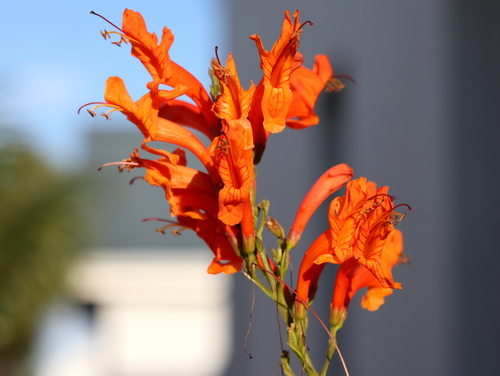
Cape Honeysuckle
Tecomaria capensis
A vibrant, nectar-rich powerhouse from Southern Africa that transforms any backyard into a bustling hub for hummingbirds and butterflies. Its trumpet-shaped blooms and evergreen foliage provide year-round beauty and vital wildlife support.
Quick Identification
Size
Grows 2-3m (7-10ft) as a shrub or up to 10m (30ft) as a scrambling vine
Colors
Brilliant orange, red, or yellow flowers with deep green, glossy foliage
Key Features
- Tubular trumpet-shaped flowers with protruding stamens
- Pinnately compound leaves with 5-9 serrated leaflets
- Scrambling or arching woody stems
When You’ll See Them
Geographic range
Where Does the Cape Honeysuckle Live?
The Cape Honeysuckle is native to the southern regions of Africa, where it flourishes in the coastal scrub and forest margins of South Africa, Eswatini, and southern Mozambique. Due to its ornamental beauty and resilience, it has been widely introduced to other warm-temperate and subtropical regions across the globe. You can now find thriving naturalized populations in parts of the southern United States—particularly California and Florida—as well as throughout Australia, New Zealand, and various Mediterranean countries.
Basemap © OpenStreetMap contributors
Behavior
Cape Honeysuckle is a vigorous, fast-growing evergreen that displays a versatile 'scrambling' growth habit. While it does not possess tendrils to climb, it uses its long, arching branches to lean on and weave through other vegetation, eventually forming a dense thicket. In backyard landscapes, it is highly adaptable and can be trained as a formal hedge, a sprawling groundcover, or a vertical screen, providing excellent nesting cover for small birds and sanctuary for garden reptiles.
As a biological powerhouse, this species is famous for its prolific nectar production. It has evolved specifically to be pollinated by birds with long, curved bills, such as sunbirds in its native Africa or hummingbirds in the Americas. Because it often blooms during the cooler months when other nectar sources are scarce, it acts as a vital fuel station for local wildlife, often becoming the most active spot in a garden during late autumn and winter.
EverydayEarth exclusive
Camera Tips
To capture high-quality footage of wildlife visiting your Cape Honeysuckle, position your camera approximately 3 to 5 feet away from a healthy cluster of open blooms. Since the primary visitors are fast-moving hummingbirds or sunbirds, an angle that is slightly offset—roughly 45 degrees to the face of the flowers—is ideal. This allows the camera to capture the bird's profile and the full length of its beak as it probes the tubular flowers.
Lighting is the most critical factor for success. Cape Honeysuckle flowers are highly reflective, so try to orient your camera facing north or south to avoid direct lens flare. Early morning and late afternoon sun will provide the best 'golden hour' illumination to make the iridescent feathers of visiting birds pop against the dark green foliage. If your camera has a macro or close-focus setting, ensure it is enabled to handle the short distance.
Because birds move with incredible speed, standard motion triggers can sometimes miss the action. Use a high-sensitivity setting and enable 'Burst Mode' or 'Photo + Video' to ensure you catch the moment of arrival. If you are using a video-first approach, a high frame rate (60fps or higher) will allow you to play back the footage in slow motion, revealing the incredible wing mechanics of your backyard visitors.
Finally, keep the area directly in front of the lens clear. Cape Honeysuckle grows very quickly, and a single arching branch swaying in the wind can trigger hundreds of 'false positive' recordings. Regularly prune back any leaves that threaten to obscure the view of the main flower clusters you are monitoring.
Frequently Asked Questions
Record Cape Honeysuckle at your habitat
Connect a camera to start building your own species record — AI identifies every visitor automatically.