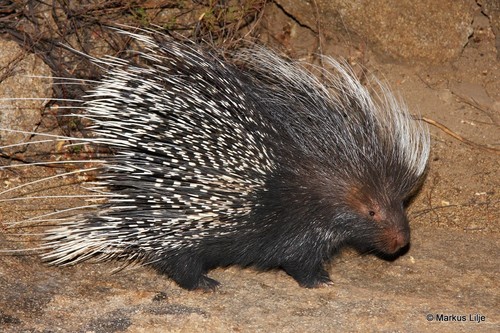
Cape Porcupine
Hystrix africaeaustralis
Africa's largest rodent is a nocturnal marvel, armored with a striking coat of black-and-white quills and a formidable personality. A master excavator and garden visitor, the Cape porcupine is one of the most rewarding species to discover on a backyard trail camera.
Quick Identification
Size
Length: 63–81 cm (25–32 in); Weight: 10–24 kg (22–53 lb), making it Africa's largest rodent.
Colors
Body covered in dark brown or black fur; quills are banded with black and white; head features a crest of long, white, bristly hairs.
Key Features
- Armor of long, sharp black-and-white quills on the back and sides
- Prominent crest of white bristles from forehead to neck
- Short, rattle-like quills at the end of the tail
- Robust, stocky body with short legs and strong digging claws
When You’ll See Them
Sightings on EverydayEarth
Jul 5, 2026
A quiet nocturnal scene shows a White Rhinoceros mother and her calf resting in a clearing. The calf is lying down, occasionally twitching its ears, while the mother is a large dark presence just behind it. Nearby, a Cape Porcupine sits calmly on the ground, its quills clearly visible in the infrared light.
Jun 30, 2026
A group of Cape Porcupines is moving through the tall grass in the middle ground. Their quills are highlighted by the infrared light as they forage under the cover of night.
Jun 18, 2026
A Cape Porcupine is seen walking across a rocky, vegetated slope at night. Its long quills are clearly visible as it moves from the center of the frame toward the left. The camera pans to follow its progress until it moves out of view behind some rocks and undergrowth.
Geographic range
Where Does the Cape Porcupine Live?
The Cape porcupine is a true African specialist, found natively across the southern and central parts of the continent. From the Cape of Good Hope in South Africa, its range stretches northward through the arid landscapes of Namibia and the lush savannas of Botswana, eventually reaching as far north as the equator in Kenya and Uganda. This resilient species is equally at home in the high-altitude fynbos of the mountains as it is in the suburban fringes of major cities like Johannesburg and Nairobi.
Basemap © OpenStreetMap contributors
Recorded on EverydayEarth
Behavior
Cape porcupines are primarily nocturnal, emerging from their burrows after sunset to forage. Though they are often seen alone, they are actually socially monogamous and typically live in family groups consisting of a breeding pair and their offspring. They are highly industrious and spend much of their night excavating roots or traveling along well-worn paths through the bush.
When threatened, the Cape porcupine does not "shoot" its quills as myth suggests. Instead, it becomes a formidable defender by fanning its quills to appear larger, rattling its hollow tail quills to create a warning hiss, and ultimately charging backward or sideways to lodge its barbs into a predator. In suburban areas, they are generally shy but can become quite bold if a consistent food source like a vegetable garden or compost heap is available.
EverydayEarth exclusive
Camera Tips
To capture the best footage of a Cape porcupine, place your camera low to the ground, approximately 30 to 50 centimeters (12-20 inches) high. These animals follow very specific 'porcupine runs'—well-trodden paths that they use night after night. Look for holes under fences or gaps in hedges where quills might have snagged; these are perfect funnel points for camera placement.
Because they are strictly nocturnal, ensure your camera has a high-quality infrared (IR) flash. Cape porcupines are large and move relatively slowly while foraging, so a standard trigger speed is usually sufficient. However, using video mode is highly recommended to capture their unique 'rattling' behavior or the way they fan their quills when investigating new objects.
If you are looking to attract one to a specific spot, they are highly motivated by scent. Overripe melons, pumpkins, or even a few scattered carrots and potatoes can keep them in front of the lens for several minutes. Be mindful that their sharp quills can occasionally brush against low-mounted equipment, so ensure your camera housing is sturdy and securely strapped to a post or tree.
Similar Species
Species that look similar or are commonly confused with Cape Porcupine.
Frequently Asked Questions
Record Cape Porcupine at your habitat
Connect a camera to start building your own species record — AI identifies every visitor automatically.