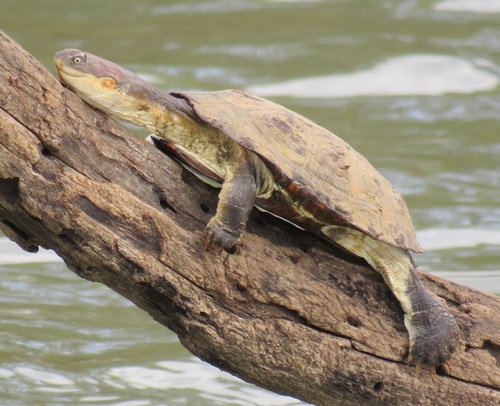
Cape Terrapin
Pelomedusa galeata
Southern Africa’s 'helmeted' pond dweller, the Cape Terrapin is a master of survival, known for its side-folding neck and its ability to thrive in both garden ponds and wild marshes.
Quick Identification
Size
Carapace length 20–32 cm (8–12.5 inches); weight up to 2.5 kg (5.5 lbs)
Colors
Olive-brown to dark brown carapace; yellowish plastron often with dark cloudy blotches; greyish-brown skin
Key Features
- Flattened, oval-shaped shell
- Side-turning neck that folds horizontally
- Smooth, 'helmet-like' scales on top of a flat head
- Strongly clawed feet with five claws on the front and four on the back
When You’ll See Them
Geographic range
Where Does the Cape Terrapin Live?
This resilient reptile is a hallmark of the Southern African landscape, found predominantly across the diverse provinces of South Africa. Its native range extends northward into the mountainous kingdom of Eswatini and reaches into the southern coastal regions of Mozambique. Unlike its cousins found further north in the rift valley, this species is a specialist of the cooler, more temperate climates of the continent's southern tip, thriving in everything from fynbos ponds to semi-arid scrublands.
Basemap © OpenStreetMap contributors
Behavior
The Cape Terrapin is a hardy and remarkably feisty reptile known for its 'side-neck' posture. Unlike most turtles that retract their heads straight back into their shells, this species folds its long neck horizontally to the side. They are highly aquatic but spend significant portions of the day hauled out on rocks or floating logs to bask in the sun, which helps them regulate their body temperature and aids digestion.
These terrapins are famous for their survival skills. When the seasonal pans and dams they inhabit dry up during the hot summer or cold winter months, they burrow deep into the mud—sometimes traveling considerable distances over land to find a suitable spot. This state of dormancy, known as aestivation, allows them to survive for months until the rains return. Despite their slow appearance on land, they are surprisingly agile swimmers and can be quite aggressive when feeding, often working together to tackle larger prey.
EverydayEarth exclusive
Camera Tips
To capture high-quality footage of a Cape Terrapin, focus your camera placement on 'basking hotspots.' Look for flat rocks, half-submerged logs, or gently sloping banks that receive direct sunlight between 10 AM and 3 PM. These reptiles are cold-blooded and must bask to survive, making these locations highly predictable. Position your camera low—about 15-20 cm (6-8 inches) off the ground—and angle it slightly downward to capture the intricate patterns of the shell and the unique side-folding neck.
If you have a backyard pond, the best placement is near the shallow 'entry point' where they crawl in and out of the water. While we don't recommend standard mammal baits, a small piece of raw fish or a few dried shrimp placed in a mesh container at the water's edge can act as a powerful lure. Because terrapins have excellent eyesight and are sensitive to movement, using a remote-triggered camera or a high-sensitivity PIR sensor is essential to avoid scaring them back into the depths.
The most exciting time to film is during the 'emergence' following the first heavy rains of spring. During this period, terrapins often move across land to find new territory. If you spot one in your garden, set your camera to 'Video' or 'Burst' mode with a fast trigger speed. They can move surprisingly quickly when they feel exposed, and a fast shutter is necessary to avoid motion blur. In suburban settings, check areas where your lawn meets a water feature, as they often use these grassy transitions to dry off.
Similar Species
Species that look similar or are commonly confused with Cape Terrapin.
Frequently Asked Questions
Record Cape Terrapin at your habitat
Connect a camera to start building your own species record — AI identifies every visitor automatically.