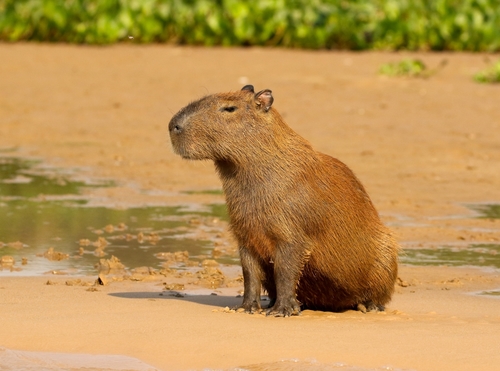
Capybara
Hydrochoerus hydrochaeris
The capybara is the undisputed king of the world's rodents—a social, semiaquatic giant that lives life at a leisurely pace. Known for their calm nature, these 'water pigs' are a delight for any backyard or trail camera enthusiast.
Quick Identification
Size
Length of 100-134 cm (3.3-4.4 ft); height of 50-62 cm (20-24 in); weight of 35-66 kg (77-146 lbs)
Colors
Coarse, shaggy fur in shades of reddish-brown, dark brown, or yellow-grey; slightly lighter on the underbelly
Key Features
- World's largest rodent with a heavy, barrel-shaped body
- Blunt, squared-off snout with high-set eyes and ears
- Partially webbed feet with four toes on front and three on back
- Dense, wiry fur designed for quick drying after swimming
When You’ll See Them
Geographic range
Where Does the Capybara Live?
Capybaras are native to nearly the entire South American continent, with the only notable exception being Chile. Their primary strongholds are found in the lush wetlands of Brazil, Colombia, Venezuela, and Argentina, where they are often the most visible large mammals. Beyond their native range, small established populations have been observed in Florida, USA, where escaped individuals have found the subtropical marshlands to be a perfect surrogate for their original homes.
Basemap © OpenStreetMap contributors
Behavior
Capybaras are remarkably social animals, typically found in groups of 10 to 20 individuals, though these herds can swell to nearly 100 during the dry season. Within these groups, there is usually a dominant male, several females, and their offspring. They communicate through a complex system of vocalizations including barks, whistles, chirps, and purrs, which help maintain group cohesion and warn of predators. As semiaquatic mammals, they spend much of their day wallowing in water or mud to regulate their body temperature and protect their skin from the sun.
While naturally diurnal, capybaras are highly adaptable and may become nocturnal in areas where they experience frequent human disturbance. They are excellent swimmers and can stay submerged for up to five minutes to evade predators like jaguars or caimans. Their calm and docile temperament has earned them a reputation as the 'friendliest' animals in the wild, often seen peacefully coexisting with birds, turtles, and even monkeys.
EverydayEarth exclusive
Camera Tips
To capture high-quality footage of capybaras, position your camera along 'game trails' that lead directly into water. These animals are creatures of habit and will use the same muddy slipways to enter and exit rivers or ponds daily. Set your camera height between 18 and 24 inches (45-60 cm) to ensure you are at eye level with these large rodents, which creates a much more intimate and professional-looking shot than a high-angle downward perspective.
Since capybaras are highly social, one of the best ways to get active shots is to find a communal 'wallow' or a sandy riverbank where they sunbathe. Use a camera with a fast trigger speed and wide-angle lens, as they often travel in groups; a narrow field of view might only catch the nose of the first animal or the tail of the last. Using 'Hybrid Mode' (capturing both a photo and a video) is excellent for capybaras, as it allows you to see their social interactions and hear their unique barking and whistling vocalizations.
If you are in a suburban area where capybaras are known to visit backyards, you don't necessarily need bait, as they are naturally attracted to well-maintained, lush green lawns. However, ensuring your camera is placed near a water feature or a damp area of the yard will significantly increase your success rate. During the dry season, they become much more concentrated around permanent water, making this the most predictable time to set up your equipment for consistent captures.
Similar Species
Species that look similar or are commonly confused with Capybara.
Frequently Asked Questions
Record Capybara at your habitat
Connect a camera to start building your own species record — AI identifies every visitor automatically.