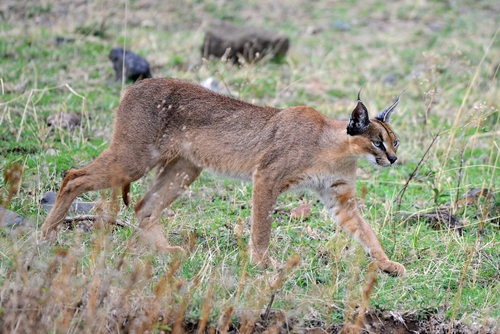
Caracal
Caracal caracal
With its iconic tufted ears and powerful golden physique, the caracal is one of the most striking wild cats on Earth. Master of the leap and ghost of the savanna, this elusive predator is a prized find for any wildlife enthusiast's camera trap.
Quick Identification
Size
Shoulder height 40–50 cm (16–20 in); Weight 8–19 kg (18–42 lb); Head-to-body length 65–90 cm (26–35 in)
Colors
Uniform reddish-tan, tawny, or sandy-gold coat; white belly and throat with faint reddish markings; distinctive black tufts on ears and black facial outlines.
Key Features
- Long, prominent black ear tufts up to 4cm long
- Robust, athletic build with powerful hind legs for leaping
- Short, uniform reddish-tan coat without spots or stripes
- Distinctive black facial markings around the eyes and muzzle
When You’ll See Them
Sightings on EverydayEarth
Jun 15, 2026
Two caracals are resting in a dark clearing. One is lying down with its head held high, while the other sits nearby. Both cats appear alert, with their distinctive ear tufts clearly visible as they monitor their surroundings.
Jun 13, 2026
Two caracals are resting together in a sandy clearing at night. The individual on the right is active, grooming its front paws and alertly turning its head to scan the environment, while the second caracal remains curled up and stationary in the background.
Geographic range
Where Does the Caracal Live?
The caracal boasts a massive geographic footprint across the African continent and parts of Asia. It is native to almost all of Africa except for the central Sahara and the densest tropical rainforests of the Congo Basin. Beyond Africa, its range extends through the Arabian Peninsula and the Middle East into Central Asia, reaching as far east as the arid scrublands of northwestern India and Pakistan.
Basemap © OpenStreetMap contributors
Behavior
Caracals are primarily solitary and highly territorial hunters, known for their incredible agility and athletic prowess. While they are capable of being active during the day if undisturbed, they are predominantly nocturnal and crepuscular, using the cover of darkness to stalk prey. They are most famous for their 'bird-snatching' ability, leaping over 3 meters (10 feet) into the air to bat birds down with their paws in mid-flight.
In social terms, caracals are elusive and generally avoid human contact. Males maintain large territories that may overlap with those of several females. Communication is handled through scent marking and a variety of vocalizations including hisses, purrs, and a unique barking sound used to call potential mates. Despite their fierce reputation as predators, they are vulnerable to larger carnivores like lions and hyenas, leading them to be masters of stealth and camouflage.
EverydayEarth exclusive
Camera Tips
To capture the elusive caracal on camera, placement is everything. These cats are creatures of habit and often use established game trails, dry riverbeds, or ridgelines to navigate their territory. Position your camera about 30 to 50 cm (12 to 20 inches) off the ground to account for their shoulder height. Aim the lens at a 45-degree angle to the trail rather than perpendicular; this increases the 'trigger window,' ensuring you get a full-body shot of the cat as it moves through the frame rather than just a tail or a blur.
Since caracals are primarily active during low-light hours, ensure your camera has a high-quality infrared (no-glow) flash. This prevents scaring the animal and keeps your equipment hidden from potential thieves or curious scavengers. While we don't recommend feeding wild predators, 'environmental lures' like a scent station using fatty acid tablets or even a small amount of catnip can encourage the cat to linger in front of the lens. Always check for local regulations before using any attractants in the wild.
Look for 'marking posts'—conspicuous rocks, stumps, or bushes where caracals might spray or scratch. These are goldmines for camera traps. In suburban-fringe areas, caracals may frequent the edges of gardens where rodents or guinea fowl congregate. Set your camera to take 'Bursts' of 3-5 photos or short 15-second videos. Their movements are lightning-fast, and a single still photo often misses the most interesting behaviors like scent-marking, grooming, or stalking.
Similar Species
Species that look similar or are commonly confused with Caracal.
Frequently Asked Questions
Record Caracal at your habitat
Connect a camera to start building your own species record — AI identifies every visitor automatically.